
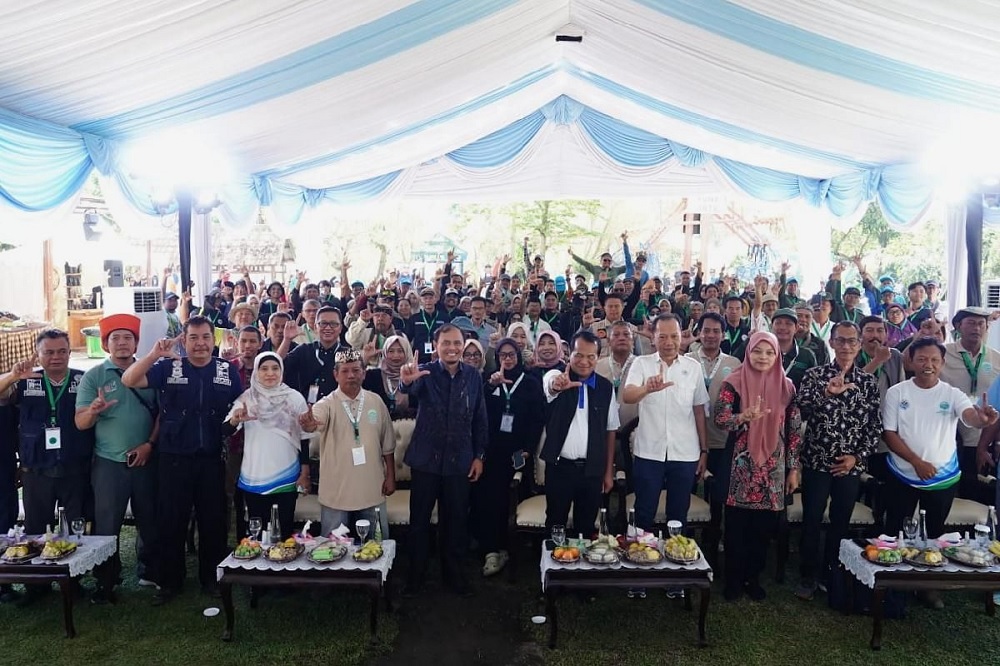
Mojokerto, en.SERU.co.id — River advocates from across the country gathered this weekend for the Indonesia River Conference 2026, where officials and community groups shared ideas on protecting and better managing the nation’s rivers and lakes.
The event took place Saturday at Wana Wisata Mata Air Sumber Gempong in Ketapanrame village, Trawas district, Mojokerto. Perum Jasa Tirta I (PJT I), the state-owned company that manages water resources, presented a session titled “Issues and Challenges in Utilizing River and Lake Water.”
PJT I President Director Fahmi Hidayat compared river networks to the nervous system and blood vessels that keep a body alive. For centuries, he said, rivers have been far more than just water sources. They have grown alongside human civilization as centers of life, farming, trade, transport and local economies.
“Rivers, lakes and reservoirs support so many sectors. They provide basic needs, raw water, irrigation for farms and industry. They also generate power, support fisheries, tourism, transport, biodiversity conservation and flood control,” Fahmi told participants.
He stressed that water use must follow five core principles: fairness, efficiency, measurability, sustainability and adaptability. These, he explained, help balance human needs, economic activity and healthy ecosystems.
“Using water is not just about how much we can take. It’s also about protecting its quality, availability and long-term health so future generations can still benefit,” he said.
The conference marked National River Day and aimed to strengthen cooperation in protecting, restoring and caring for rivers. It also supports the National Ecological Conversion program launched by the Ministry of Environment and the Environmental Control Agency.
Discussions covered water quality, environmental funding, permits and authority over river use, riverside boundary rules, waste management, conservation tourism and community-based river monitoring.
Read Also:
Perum Jasa Tirta I Sends Off 377 Free Mudik Participants to 9 Cities in Java for Lebaran 2026
Fahmi outlined several pressing challenges. Changes in land use and growing areas of critical land upstream are speeding up sedimentation, slowly reducing reservoir capacity. Climate change is shifting rainfall patterns, bringing surplus water in the wet season and possible shortages in the dry months. Rising population and economic activity keep driving up demand for water, making careful allocation essential for households, farms, public services, industry, energy and the environment.
Other hurdles include limited public awareness of water’s true value, weak planning and funding coordination between agencies, and inconsistent enforcement of rules against violations.
Success, he argued, cannot rest only with government or water managers. Local river communities play a vital role through environmental education, monitoring river conditions, preventing pollution and leading conservation work on the ground.
As a state-owned water manager, PJT I oversees river basins, water quantity and quality, river environments, infrastructure operation and maintenance, and flood mitigation in its working areas.
Through its participation in the conference, the company reaffirmed its commitment to integrated, sustainable water management and closer partnership with river communities nationwide—so rivers remain sources of life and a lasting inheritance for the next generation. (*/rhd)