
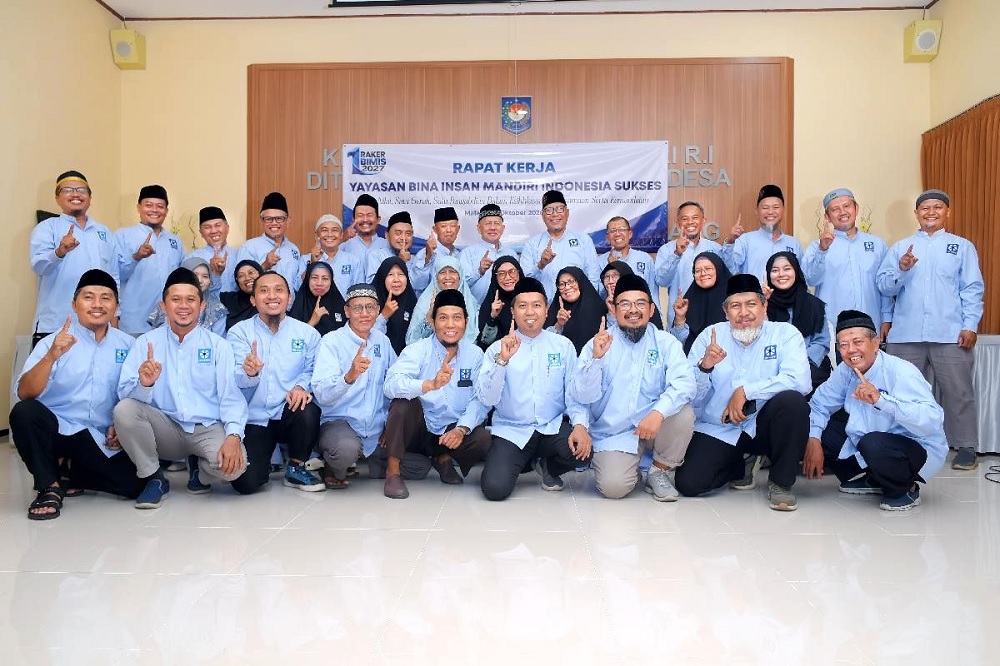
Malang, en.SERU.co.id – The Working Meeting of the Bina Insan Mandiri Indonesia Sukses Foundation (BIMIS) synergized the development of four work units related to Hajj and Umrah guidance. It took place at the Hall of the Malang Village Government Center, Jl Raya Langsep 7 Malang City, on Saturday, 17 October 2026.
BIMIS Secretary Jufri said that although the foundation was established in 2010, with thousands of members now formed, BIMIS is beginning to develop four work units in 2026. Previously there was only LBIH Mandiri, as an institution for Hajj and Umrah guidance that has focused on providing free and professional Hajj ritual training (manasik) since 2007.
“LBIH Mandiri existed earlier since 2010 and was only legalized through the BIMIS Foundation in 2010. And was renewed in 2026, with development into four work units,” said Jufri.
Four Work Units of the BIMIS Foundation
The four work units under the BIMIS Foundation include:
- LBIH Mandiri.
A work unit for Hajj and Umrah worship guidance that emphasizes free and professional coaching. - Mandiri Islamic Centre (MIC).
A work unit for the development of manasik areas, Islamic education, community coaching, and educational tourism. - Keluarga Haji LBIH Mandiri (KAHAMAN).
As a platform for friendship, post-Hajj coaching, and social service of alumni. - Lembaga Pelayanan dan Bimbingan Haji–Umrah (LPBHU) Insan Mandiri.
As a platform for service and coaching of non-KBIHU pilgrims as well as a stage of institutional development.
All activities of the four work units are facilitated and socialized through the development of the BIMIS digital ecosystem. Through the integration of the Website bimis.id and the Application lbihmandiri.id.
“Database management is handled by the BIMIS secretariat team to facilitate the existing work units,” added Jufri, accompanying BIMIS Foundation Chair Syaifuddin Aryus.
BIMIS Financial and Asset Report
Before the presentation of each work unit, BIMIS Foundation Treasurer Bayuaji SE Ak delivered the financial and asset reports owned. One of them is the financial condition of the last four years 2022-2026 and the development target of the Mandiri Islamic Centre (MIC). Namely a manasik practice area, Islamic education, community coaching, and educational tourism in the Langlang Tirtasani area.
“Alhamdulillah, because this is worship work in order to maintain the mabrur of the alumni’s Hajj, the assets and cash balance of BIMIS are purely from them. Both in the form of waqf, grants, infaq, and zakat from the LBIH Mandiri Hajj alumni since 2012 until 2026,” explained Bayu.
LBIH Mandiri Work Program
As the longest-standing unit—active since 2007—LBIH Mandiri has consistently provided Hajj and Umrah guidance through professional, free-of-charge instruction. Its annual operational costs, amounting to approximately IDR 85 million (roughly IDR 7 million per month), are covered by the organization’s alumni. Meanwhile, prospective Hajj pilgrims (CJH) for the year 2027 receive this Hajj guidance entirely free of cost.
“Usually, CJH when participating in manasik at other places have to pay, at LBIH Mandiri it is free. We the alumni are the ones who bear the operational costs, every Saturday at the Muhajirin Mosque up to manasik practice before departure,” explained Coach Dian, spokesperson for LBIH Mandiri.
The involved team works voluntarily, as part of efforts to maintain the mabrur of Hajj and repay kindness. Because of the pattern applied, alumni are obliged to serve the guests of Allah SWT (duyufurrahman), because when they were prospective Hajj pilgrims, they previously received free service. So that pilgrims who have just departed for Hajj are given the opportunity to serve duyufurrahman prospective Hajj pilgrims, in whatever form.
Mandiri Islamic Centre (MIC) Work Program
The MIC work unit is developing a manasik area, Islamic education, community coaching, and educational tourism in the Langlang Tirtasani area. This MIC area is targeted to become the location of a miniature series of Hajj rituals, both the pillars of Hajj and the obligations of Hajj, the largest in Greater Malang.
Currently the facilities that already exist and are being built include:
- Miniatur Ka’bah and Sa’i Area,
- Arafah, Muzdalifah, and Mina Area,
- Jamarat Area,
- Tracking/jogging path, park, lighting, fence, and parking.
“This MIC area has already been used by prospective Hajj pilgrims in 2026, and continues to be in process,” said Acting Chair of MIC, Yuniar Risdiyanto Rizki.
Meanwhile facilities heading toward the construction process include Hajj manasik study building; space for recitation, coaching, training, and learning of Hajj manasik for pilgrims; multipurpose building/office; toilets and utilities; dormitory/Guest House.
“The RAB target is around Rp9.5 billion, if all facilities and infrastructure have been fully built,” he concluded.
Read Also:
2027 Hajj Fees Set With Average Final Payment Around Rp23 Million
Keluarga Haji LBIH Mandiri (KAHAMAN) Work Program
As a platform for friendship, post-Hajj coaching, and social service of alumni, KAHAMAN is currently inventorying around 1,510 alumni since 2012. The plan is that alumni and partners will be involved in all programs from the current four work units.
“Currently, we have only been able to gather around 340 alumni who have reunited. The hope is that by the end of the year we can gather all of them in a gathering, so that the bonds of friendship remain connected,” said Chair of KAHAMAN, Syaifullah Santoso.
Lembaga Pelayanan dan Bimbingan Haji–Umrah (LPBHU) Insan Mandiri Work Program
As a platform for service and coaching of non-KBIHU pilgrims, as well as a stage of institutional development. LPBHU has a different concept from KBIHU in general, because the prospective Hajj pilgrims who join undergo strict selection.
“So, we do not compete with KBIHU, because the CJH who join sign a commitment that is not easy. There is even a pre-test and post-test,” said Spokesperson of LPBHU IMAN, MT Cahyo.
The objectives of the LPBHU IMAN Work Program for 2026–2027 include:
- Forming resilient Hajj pilgrims who are ready to face challenges.
- Strengthening competence through assessment, coaching, and targeted mentoring.
- Instilling the values of sincerity, independence, discipline, and togetherness.
- Improving readiness in knowledge, physical, mental, and spiritual aspects according to the scope of coaching.
- Helping pilgrims maintain mabrur after performing the Hajj.
(rhd)