
Malang, en.SERU.co.id – The Deputy Minister of Higher Education, Science, and Technology (Wamendiktisaintek) of the Republic of Indonesia reminded the academic community not to become dependent on the use of Artificial Intelligence (AI). Meanwhile, the original purpose of studying is to elevate the potential of students’ core abilities, so they are ready to compete in the business world, the industrial world, and the world of work (dudika).
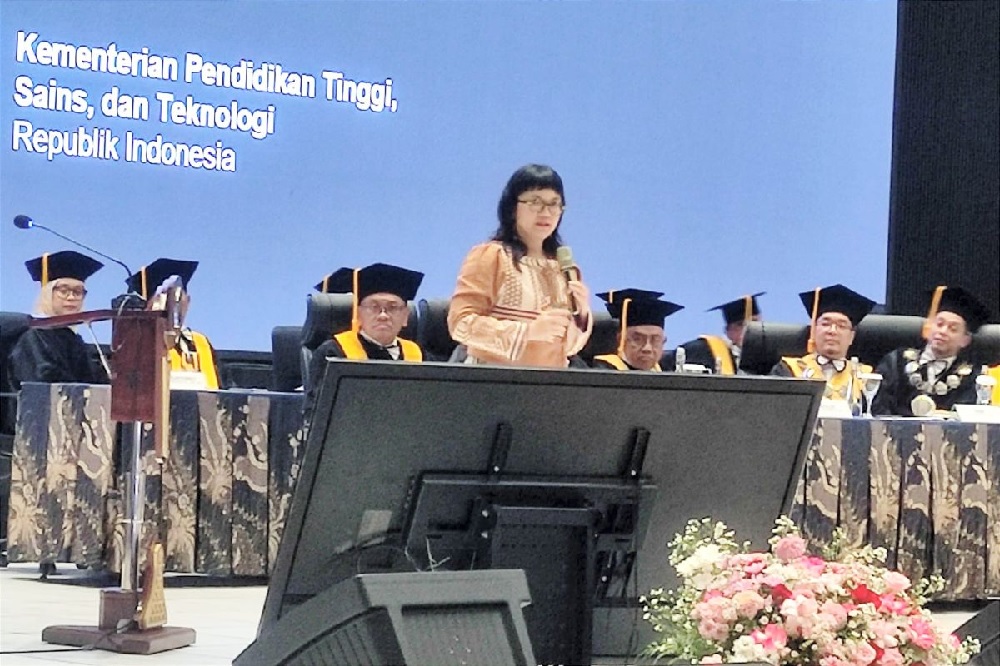
Wamendiktisaintek Prof. Stella Christie PhD stated that globally no party is truly ready to face the rapid exponential development of AI. Nevertheless, the higher education sector is considered the most prepared to adapt, because AI itself was born from the academic environment.
“AI was born from a meeting at Dartmouth University in 1956. Because it was born from the university, I am confident that higher education is able to face it. However, our main focus is no longer providing AI application training, because students today actually understand it better than their lecturers,” said Prof. Stella, as she is addressed, in a scientific oration at the 65th Dies Natalis of FEB UB titled “Creating Future-Ready Leaders: Integrating Human Intelligence, Technology, and Sustainable Development” on Monday, October 19, 2026.
Higher Education Safeguards Students’ Core Abilities
In facing artificial intelligence AI, higher education is not merely teaching the technical operation of applications. Rather, it safeguards so that the utilization of AI does not erode the core abilities of students.
According to Prof. Stella, the crucial matter that needs to be evaluated together by lecturers and students is to straighten out again the intention and main purpose of pursuing higher education. Meanwhile, the use of AI merely as a tool for completing assignments or summarizing materials must not limit the depth of a person’s understanding of academic material.
“We must together think about our role when creating knowledge, our purpose in transmitting knowledge. And are we still able to curate knowledge, if we instead rely on AI, without us realizing that AI makes us dumber,” added this Cognitive Scientist from Medan, North Sumatra.
Negative Impacts of Dependence and Evaluation of AI Use
She stated that data shows the negative impacts of excessive dependence on AI technology. Students who use AI intensively every day tend to experience a decline in performance and have a shallower level of knowledge depth.
Meanwhile, those who hone independent thinking abilities use AI technology only as a supporting aid. So that they still have a wider level of knowledge depth and better performance.
“The purpose of studying is to gain deep understanding as well as real abilities so as to be ready for the world of work. If our knowledge is instead under the reliability or control of AI, we will find it difficult to compete in the world of work,” stressed this Professor from Tsinghua University China in 2022.
This recipient of a PhD degree from Northwestern University in the field of cognitive psychology added that neither the ministry nor higher education leaders intend to ban the use of AI. However, in-depth discussion is needed regarding the limits of its utilization, so as not to damage the essence of learning during the four years of study.
“The simple indicator is: if without AI students still have those abilities and skills, please go ahead and use the AI. However, if using AI the students’ abilities actually decline or disappear, then that utilization of AI must be stopped immediately,” concluded Prof. Stella.
Read Also:
FSTeM UB Strengthens Global Research Competitiveness Through BASIC 2026
UB Rector Affirms Use of AI and the Essence of Lectures
Rector of Universitas Brawijaya (UB), Prof Widodo SSi MSi PhD MedSc, reminded to be wise in the utilization of artificial intelligence or Artificial Intelligence (AI) in the higher education environment. AI should only be positioned as a tool to accelerate understanding, not to replace the process of knowledge creation by humans.
The Rector of Universitas Brawijaya revealed that the main essence of lectures in higher education is to develop competencies as well as to generate and understand knowledge. The presence of AI is equated with the calculator in the early days of its appearance that once triggered pros and cons but is now accepted merely as an academic aid.
“AI is like us using a calculator. That tool cannot replace our role to create knowledge. Remember that the fuel of AI is knowledge. If humans stop creating knowledge, then AI will also not become smart,” stressed Prof Widodo.
The main criterion that cannot be replaced by AI technology is the human ability to curate knowledge. Namely distinguishing between information that is true and not true, as well as applying it for the right purposes.
UB Rector Regulation Safeguards Academic Integrity and Ethics
He stated that in safeguarding academic integrity and ethics, Universitas Brawijaya has issued a Rector Regulation (Pertor) regarding guidelines and procedures for the utilization of AI for the academic community. This regulation becomes the operational foundation in balancing technological progress with academic standards.
“Regarding supervision of students, UB applies a strict scanning mechanism (screening) of all scientific works. Starting from theses up to research publications. This step is carried out to check the level of plagiarism, as well as detect indications of AI misuse in the creation of academic works,” he concluded. (rhd)