
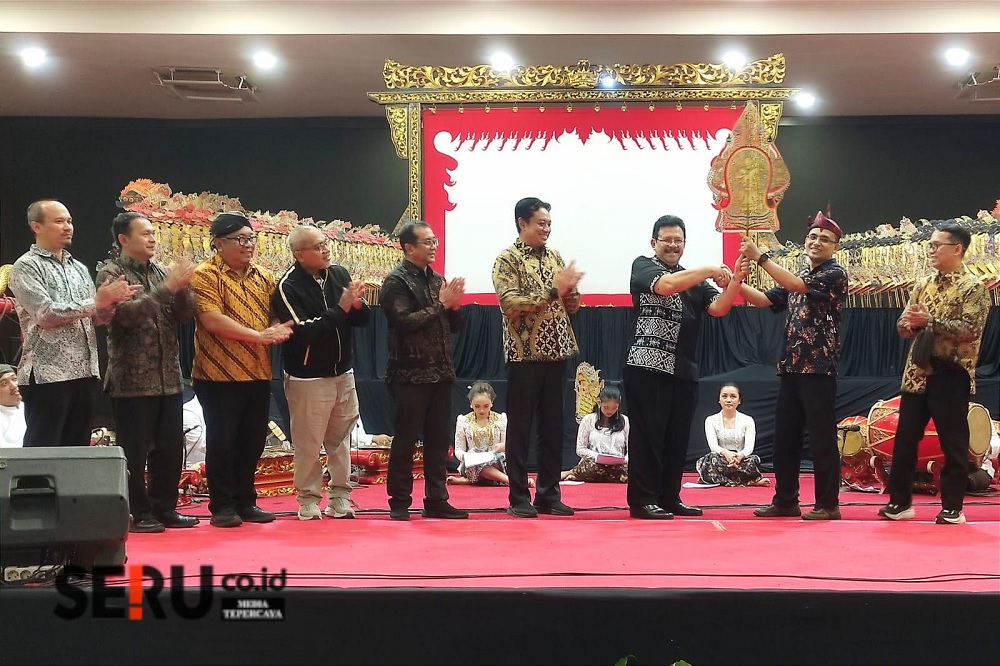
Malang, en.SERU.co.id – Universitas Brawijaya (UB) staged a Contemporary Wayang Kulit Performance with the story “Mutiara Kerang Kencana” as an implementation of the Brawijayan Character at the Samantha Krida Building UB on Saturday evening, October 3, 2026. This annual agenda was attended by new students (maba) from the Faculty of Cultural Studies (FIB) and the Faculty of Fisheries and Marine Science (FPIK), including lecturers from both faculties.
Chair of the Organizing Committee Dr. Fuad SPi MT explained that the wayang performance is one of the media for internalizing the values of the Brawijayan Character to the academic community as well as the wider public. It serves as a meeting space between traditional arts, character education, and global insight.
“The hope is that the Brawijayan Character is not only understood as a concept but can also be planted and realized in daily behavior,” said Fuad.
He noted that the contemporary wayang kulit performance is packaged in a modern and collaborative manner so that it can easily bring noble values closer to the younger generation (Gen Z and Gen Alpha). It is also part of the series of PK2MABA UB (Introduction to Campus Life for New Students of Universitas Brawijaya).
Third Year of Contemporary Wayang Performance
Dr. Fuad explained that the 2026 performance becomes a milestone of the third year of the contemporary wayang journey, this time carrying the Brawijayan Character. It began in 2024 with the performance of the Dewa Ruci story at Universitas Brawijaya as a medium for reflection on the search for self-identity and purification of the heart.
In 2025, it developed to the international level through the organization of a performance at the Indonesian School of Kota Kinabalu (SIKK), Malaysia. This allowed the values of the Brawijayan Character to be introduced to Indonesian communities and educational communities abroad.
“In 2026, the program returns to Universitas Brawijaya with the story ‘Mutiara Kerang Kencana’ raising the themes of character, virtue, and Brawijayan spiritual awareness. It collaborates with Sanggar Seni Gumelaring Sasangka Aji Bunulrejo,” explained Fuad.
Uniqueness of the Contemporary Wayang Kulit Performance
Through the Globalizing Universitas Brawijaya (GUB) program, various forms of Nusantara culture continue to be presented in wider dialogue spaces. The Contemporary Wayang Kulit Performance “Mutiara Kerang Kencana” Brawijayan Character is one of Universitas Brawijaya’s efforts to strengthen its identity.
“By cultivating the character of the academic community and introducing the richness of Indonesian culture to national and international society,” he said.
The uniqueness of this Contemporary Wayang Kulit Performance involves many puppeteers, a separate narrator, singers, as well as modern lighting and music. The musicians and percussionists come from the Gen Z and Gen Alpha generations.
“The inter-faculty collaboration between FPIK and FIB is visible from the storyline. FPIK represents Indonesia’s maritime identity as an archipelagic country, while FIB brings the noble values of culture,” he stressed.
Contemporary Wayang Kulit Performance as Part of Globalizing UB Program
The Contemporary Wayang Kulit Performance is part of the Globalizing Universitas Brawijaya (GUB) program under the coordination of Vice Rector IV for Planning, Cooperation, and Internationalization. Through this performance, UB seeks to introduce the values of the Brawijayan Character through the medium of Nusantara cultural arts, while at the same time strengthening the university’s identity in a global context.
Vice Rector IV of Universitas Brawijaya Prof. Andi Kurniawan SPi MEng DSc emphasized that the internationalization of higher education must go hand in hand with the strengthening of cultural identity.
“Becoming part of the global community does not mean having to leave behind the nation’s identity. On the contrary, culture and local values are an important foundation in building character and expanding the contribution of Universitas Brawijaya at the international level. We hope that the Brawijayan Character, which is rich in local values and nobility, can continue to be echoed until it provides a global impact,” he said.
According to Prof. Andi, the Brawijayan Character is part of the process of searching for identity that places culture as one of the important sources of learning in understanding knowledge and life. In addition to being a medium for character education, this performance has a connection with the series of World Water Monitoring Day (WWMD) 2026 at Universitas Brawijaya.
“The philosophy of water, which is one of the foundations of the Brawijayan Character, provides a broader perspective on the importance of maintaining the sustainability of water resources as a source of life as well as a symbol of care and shared responsibility. Just as the connection between FPIK and FIB, this performance becomes a learning medium in understanding knowledge and life,” he explained.
From Brawijaya for Indonesia and the world, this performance carries the message that global progress can go hand in hand with cultural preservation and the strengthening of noble character.
Read Also:
Universitas Brawijaya Takes First and MAN 2 Malang Third in Indonesia Sharia Olympiad 2026
Essence of Brawijayan Character Thought
The conceptual initiator of the Brawijayan Character, Prof. Dr. Iwan Triyuwono, conveyed the essence of the thought contained in the book titled “Filosofi Air: Menghidupkan Kehidupan melalui Karakter Brawijayan.” Prof. Iwan explained that the Brawijayan Character is based on the philosophy of “The Pure Soul that Always Wins.” It is a way of thinking and behaving that is not only oriented toward academic achievement, but also the ability to enliven life through meaningful actions.
“Water becomes the main metaphor in the Brawijayan Character. Water flows, gives life, adapts, and brings benefits to its surroundings. These values are expected to be reflected in the behavior of academic people who are integrity-driven, caring, wise, and responsible,” he explained.
According to Prof. Iwan Triyuwono, the word “Brawijayan” comes from the word Brawijaya and the suffix -an, meaning the model or character of Brawijaya. Brawijaya itself consists of the words Bra (Batara/pure soul) and Wijaya (victory).
“The main concept is the process of educating the entire academic community—students, lecturers, and educational staff—to have a pure soul. From a pure soul, a person will be connected to the true self (Nur Muhammad/Holy Spirit/Atman), so that they radiate love that enlivens life. Or Urip iku Urup,” he said.
There are three main values of the Brawijayan Character: Pure, Divine, and Love. These three main values are developed into 11 Brawijaya Characters, among others: Pure, Divine, Love, Resilient, Tactical, Visionary, Innovative (Wira Cipta), Loyal, Authoritative, Tolerant, and Warrior/Knight.
“The hope is that UB alumni can grow into Pandita Brawijayan (figures of high spiritual and intellectual stature) or Kesatria Brawijaya (executors/leaders who are intellectual and spiritual). Capable of realizing a civilization full of love (gemah ripah loh jinawi, toto tentrem kerto raharjo),” he concluded.
Collaboration with Sanggar Seni Gumelaring Sasangka Aji (GSA)
This year’s performance was held through collaboration with Sanggar Seni Gumelaring Sasangka Aji (GSA) led by Rachmad Dian Kuncoro, MLing. As a collaboration partner, Sanggar GSA at Jl. Hamid Rusdi No. 46, Bunulrejo, also develops a contemporary wayang approach that remains grounded in the philosophical values of Nusantara culture.
The performance of “Mutiara Kerang Kencana” was presented by Ki Tri Sulo and Ki Daniswara as puppeteers and performers. This story raises a reflective journey that invites the audience to understand the meaning of virtue, responsibility, diversity, and spiritual awareness as the foundation for character formation.
“The storyline recounts Bima’s search in finding God and his true self. After finding faith and knowledge, Bima practices them for the wider community, even though he faces various temptations from the Kurawa,” explained Rachmad.