

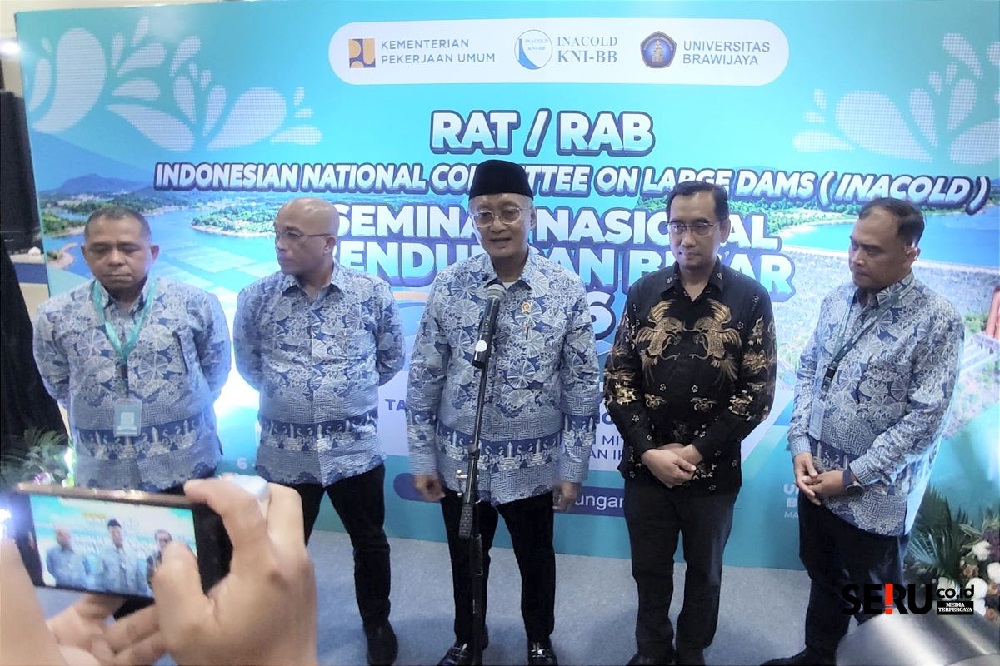
Malang, en.SERU.co.id – The Ministry of Public Works (Kementerian PU) is carrying out an evaluation of the revitalization and role of large dams in supporting water resilience, food security, and national energy. At the same time strategic infrastructure to face the challenges of climate change.
Minister of Public Works of the Republic of Indonesia, Ir. Dody Hanggodo MPE, stated that the management of large dams is strategic infrastructure in supporting the achievement of national water, food, and energy resilience. Therefore it needs to continue to be optimized, so that it can provide the greatest benefits for the prosperity of the people.
“The Ministry of Public Works is committed to evaluating and revitalizing the old dams throughout Indonesia whose quality is beginning to decline. This step is carried out in order to optimize the function of water infrastructure in supporting national food, energy, and water resilience amid the challenges of natural phenomena that are increasingly dynamic,” said Dody, after opening the National Seminar on Large Dams 2026, at the Faculty of Engineering of Universitas Brawijaya (FTUB) Malang City, on Friday-Saturday, November 6-7, 2026.
He stated that many dams in Indonesia have already been decades old, even some that were built since the Dutch colonial era. Therefore, preservation as well as re-examination of the effectiveness of dams becomes a priority so that they can function maximally.
“We look back, what we have already built we must preserve. Then those that are already standing we look at again. If not yet maximal for supporting food, energy, and water resilience, we maximize,” stressed Dody, in the event themed “Strategy for Strengthening Large Dam Governance for Adaptation and Mitigation of Climate Change Impacts.”
As information, the Ministry of Public Works together with the Indonesian National Committee for Large Dams (KNI-BB) or INACOLD held a series of activities. Among them the Ordinary Member Meeting (RAB), Annual Member Meeting (RAT), and National Seminar on Large Dams 2026.
In agreement, General Chair of INACOLD, Adenan Rasyid, conveyed the urgency of innovation in water resource governance. Dams are one of the water resource infrastructures that become the lifeblood of the nation’s life. At the same time a provider of domestic clean water, the backbone of agricultural irrigation, and a driving force for the clean energy transition.
“We are in an era where climate change demands us to think more advanced and adaptive. Through strong cross-sector collaboration, we are optimistic we can give birth to innovative and sustainable water resource infrastructure management,” he said.
As a real form of the application of theory and innovation, the series of activities on the first day began with a field visit (Field Trip) to Sutami Dam. Next to the area of the Karangkates Floating Solar Power Plant (PLTS).
Read Also:
Education Ministry Introduces Humane School Orientation Program MPLS Ramah 2026
Chair of the Organizing Committee of the National Seminar on Large Dams 2026, Fahmi Hidayat, explained the added value of that field visit agenda. Participants were invited to directly review Sutami Dam in Malang Regency which is currently managed by Perum Jasa Tirta I.
“In this area, participants not only see the operation of the 105 MW hydroelectric power plant but also review the location of the National Strategic Project development in the form of a Floating Solar Power Plant with a capacity of 130 MWp. This integration of hydro and solar energy is aligned with the subtheme of energy transition and national water resilience that we are echoing,” explained the President Director of Perum Jasa Tirta I.
In addition to the field review, this series of strategic agendas was filled with scientific discussions, paper presentations, Young Professionals Forum. As well as a coaching clinic that discusses various challenges of dam construction and management.
“A number of strategic issues also become the focus of discussion, starting from dam safety, optimization of reservoir operations, climate change adaptation. Up to the application of technology in the management of water resource infrastructure,” added Fahmi.
Through the KNIBB National Seminar 2026, collaboration between the government, academics, practitioners, and dam managers is expected to become increasingly strong. In producing various strategic recommendations in order to realize dam management that is more resilient and adaptive. As well as sustainable for supporting national water resource resilience. (rhd)