
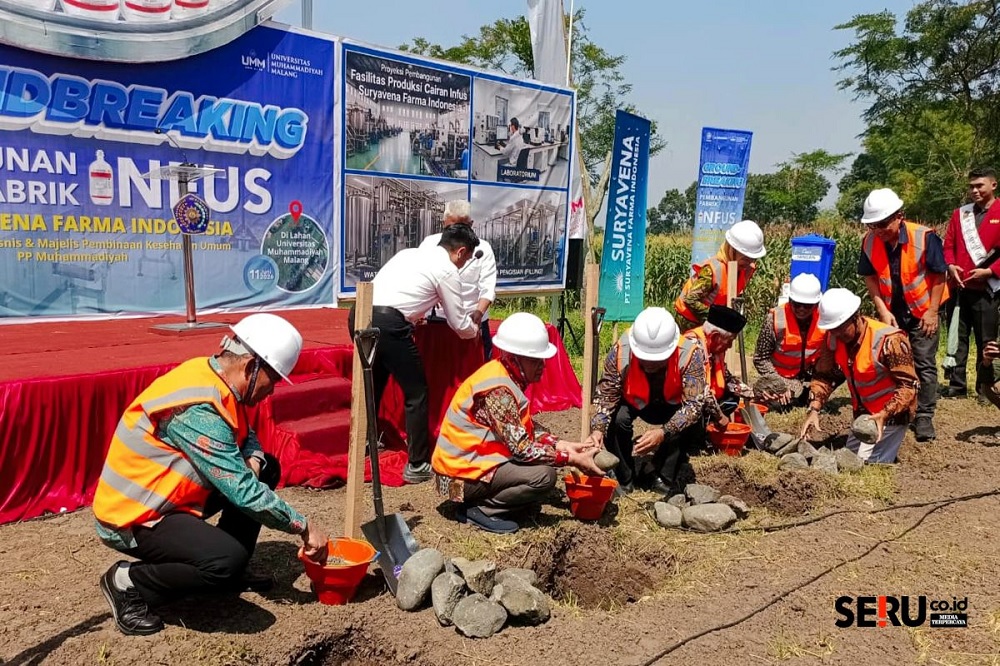
Malang, en.SERU.co.id — Muhammadiyah’s central leadership (PP Muhammadiyah) has taken a significant step to strengthen its economic footprint by launching construction of the Suryavena infusion factory in Karangploso District, Malang Regency.
The organization, which already operates 130 hospitals serving communities across Indonesia, aims to enhance self-reliance in the health sector while helping elevate the nation’s people-centered economy.
Speaking after the groundbreaking ceremony on Thursday, June 11, 2026, PP Muhammadiyah Chairman Haedar Nashir said the project reflects Muhammadiyah’s commitment to moving beyond small-scale enterprises.
“We’re building an ecosystem where the people’s economy can rise to the middle and upper levels. We’ve long supported MSMEs, and now it’s time to develop larger-scale businesses that can empower the ummah more broadly,” Haedar said.
He emphasized that true empowerment means giving people not just jobs or aid, but real involvement in building the economy together. According to Haedar, Muhammadiyah’s vast social, economic, and religious networks give it the capacity to operate in medium-to-large industries — a move that aligns with Indonesia’s vision of becoming a self-reliant “Golden Indonesia.”
“National independence will never be achieved if we continue depending on outsiders to manage our natural resources and economic potential,” he added, linking the initiative to Article 33 of the 1945 Constitution, which focuses on the welfare of the people.
The choice of infusion production is strategic. With its network of 130 hospitals and hundreds of clinics, Muhammadiyah requires a steady, reliable supply of medical products.
“By building our own factory, we can meet our internal needs independently. I’m confident we’ll expand into medicines and other areas in the future. Once you start something like this, other initiatives tend to follow,” Haedar explained.
Read Also:
UMM Officially Becomes UNESCO Chair for Sustainable Water Ecosystem
Efficiency and Quality Focus
Muhadjir Effendy, Chairman of PP Muhammadiyah’s Council for Economy, Business, and Halal Industry, noted that PT Suryavena has already been producing infusions for two years through a contract manufacturing (maklon) arrangement.
“Having our own factory will improve efficiency, strengthen quality control, and reduce production costs. If we can offer competitive prices, the products should appeal not only to Muhammadiyah facilities but to the wider market as well,” Muhadjir said.
The project is a collaboration between PP Muhammadiyah and Universitas Muhammadiyah Malang (UMM), which is both a shareholder and the provider of the land. Several major Muhammadiyah hospitals have also taken equity stakes.
Operations will be coordinated by the organization’s Health Council and Economy & Business Council — a model of internal synergy that Muhadjir hopes other councils will replicate in their respective fields.
“This is a collaboration between two Muhammadiyah councils. In the future, more councils will develop industries suited to their own strengths,” he said. (bas/mzm)