
Malang, en.SERU.co.id – As Eid al-Adha approaches, the public has begun flocking to livestock markets to purchase sacrificial animals. A livestock expert from the University of Muhammadiyah Malang (UMM) is urging buyers not to consider body size alone. The animal’s health, physical condition, and age must all comply with Islamic law to ensure the sacrifice is valid and the meat is safe for consumption.
Lili Zalizar, a lecturer in the Animal Husbandry Study Program at UMM’s Faculty of Agriculture and Animal Husbandry, called on the public to be more thorough before purchasing. She stressed that the animal’s health must be the top priority.
“This is related to the validity of the worship as well as the safety of the meat to be consumed,” Lili stated in a release received by SERU.co.id on Friday (8/5/2026).
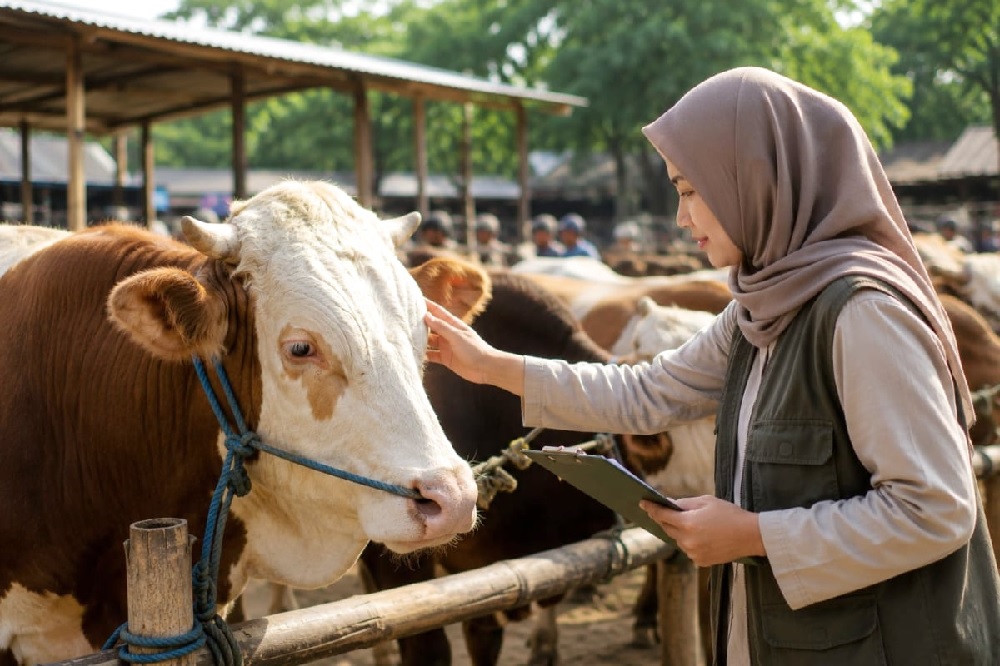
According to Lili, a basic health check can actually be done simply, through direct physical observation at the point of sale. The first step is to observe the animal’s posture and stance.
“First, we look at the livestock from the front, side, and back. Make sure the animal can stand upright and is not limping,” she said.
She explained that animals with physical defects, such as lameness, are not permitted for sacrifice under Islamic law. Therefore, body balance and the condition of the legs are important indicators that prospective buyers must check.
“The public must also pay attention to the condition of the animal’s eyes and skin. A healthy animal generally has clear, unclouded eyes. The presence of a white membrane or vision impairment can be a sign of health problems,” she added.
The condition of the skin should not be overlooked either. Sacrificial animals should ideally be free from skin diseases such as mange or scabies.
“For the sacrifice, choose one with smooth skin and no mange. Because we want to sacrifice the best animal,” she added.
Read Also:
UMM Officially Becomes UNESCO Chair for Sustainable Water Ecosystem
Lili also reminded the public to be aware of dangerous infectious diseases, particularly those that can attack livestock, such as Foot and Mouth Disease (FMD) and Anthrax.
“An animal indicated to have FMD usually shows symptoms such as excessive salivation, lesions on the tongue and gums, and inflammation between the hooves. An animal affected by anthrax may experience seizures accompanied by bleeding from the nose or anus,” she emphasized.
Beyond ensuring health, prospective buyers are also advised to observe the animal’s appetite and activity level. Healthy animals are generally active, eat voraciously, and look fit. The public is advised to choose animals that are plump but still healthy.
Equally important, the age of the sacrificial animal must meet religious requirements. Citing NU Online, the minimum age requirements are as follows:
-
Cows and buffalo: at least two years old.
-
Sheep: at least one year old or have had a change of teeth.
-
Goats: at least over one year old.
-
Camels: at least five years old.
In a hadith narrated by Al-Barra bin Azib, the Prophet Muhammad (PBUH) explained that four types of animals are invalid for sacrifice: a blind animal, a sick one, a lame one, and one so emaciated that it has no marrow in its bones.
However, some defects are still tolerated, such as a broken horn or castration. Conversely, an animal with a defect that results in a missing body part, such as a severed ear or tail, remains invalid for sacrifice.
Lili also emphasized the importance of observing the animal’s condition before slaughter. Animals that have just traveled a long distance should be rested first to prevent stress.
“Fatigue in livestock can trigger DFD (Dark, Firm, Dry) syndrome, a condition where the meat quality declines, becoming darker, tougher, and drier in texture,” she explained.
In Al-Majmu’ Syarah Al-Muhadzdzab, Imam Nawawi explains that the best sacrificial animal is one with the most perfect physical form, the best health, and the greatest benefit of its meat for the recipients.
Through this education, the public is expected to become more discerning in choosing their sacrificial animals. The act of sacrifice is not merely an annual tradition but also a form of concern for food quality and a religious practice that must be performed according to Islamic law. (aan/mzm)