

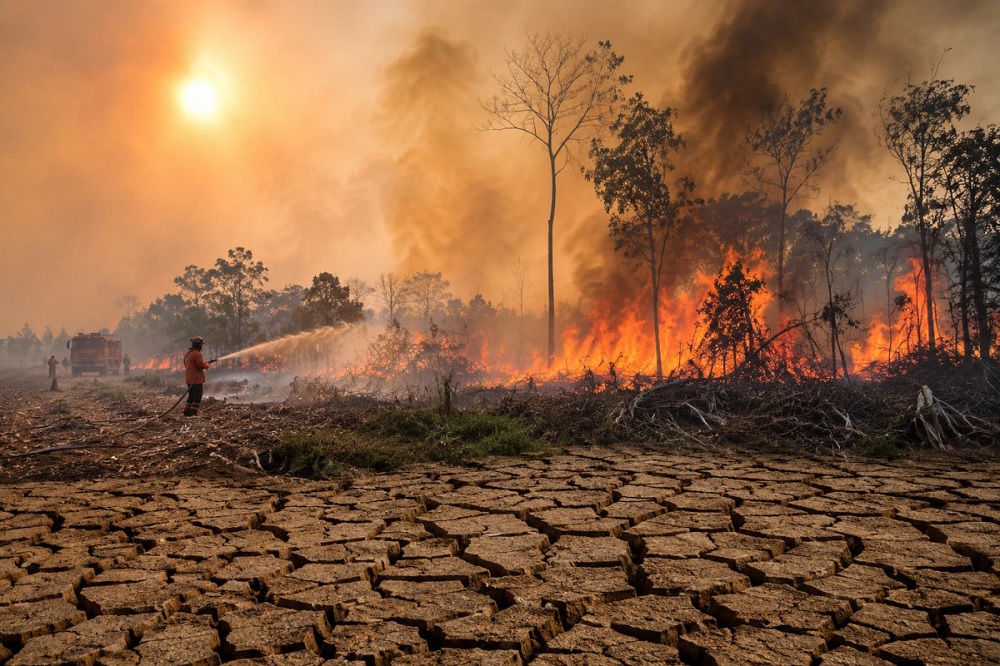
Jakarta, en.SERU.co.id — Indonesia’s meteorological agency has forecast a longer and drier dry season in 2026, driven by the potential development of El Niño and broader global climate variability. The outlook has raised concerns over heightened risk of forest and land fires (karhutla), particularly in fire-prone regions such as Riau and Kalimantan.
BMKG chief Teuku Faisal Fathani said most parts of the country are expected to enter the dry season between April and June this year — earlier than usual. As of late March 2026, about 7 percent of seasonal zones (ZOM) had already begun their dry period, with the number projected to rise significantly.
“Rainfall during this dry season is forecast to be below normal compared to the 30-year average,” Faisal said, citing BMKG modeling. While the El Niño-Southern Oscillation (ENSO) and Indian Ocean Dipole (IOD) are currently neutral, forecasts indicate ENSO could shift toward El Niño in the second half of 2026, further exacerbating drought conditions.
Government ramps up preparedness
In response, the government is intensifying preventive measures, including aerial patrols and strengthened early warning systems.
Forestry Minister Raja Juli Antoni warned that the prolonged dry spell could lead to more extensive fires than last year. He urged communities and plantation companies to exercise greater caution, especially when clearing land.
“Using fire for land clearing is extremely risky and can easily trigger widespread blazes,” he said.
Read Also:
Hantavirus Warning in Malang Symptoms Like COVID-19 and How to Stay Safe
Sharp rise in hotspots and burned areas
Data from the Sipongi monitoring system shows a dramatic increase in fire activity. Between January 1 and April 5, 2026, authorities detected 702 hotspots — a sharp jump from only 125 in the same period of 2025.
Burned areas have also grown significantly. From January to February 2026, fires scorched 32,637 hectares, with an additional estimated 10,175 hectares burned in March. Riau has been the hardest hit, with around 8,858 hectares affected, followed by West Kalimantan, Central Kalimantan, East Nusa Tenggara, and the Riau Islands.
To tackle the threat, the National Disaster Management Agency (BNPB) has readied 16 water-bombing helicopters and 12 patrol helicopters. The government is also deploying weather modification operations (cloud seeding) to moisten peatlands and other high-risk zones.
Echoes of 2015 haze disaster
Academic Fiqri Ardiansyah from Universitas Gadjah Mada’s Faculty of Forestry noted that weather is only part of the problem. Weak enforcement, poor land management, and the continued use of fire for land clearing — especially on peat soils — remain major contributing factors.
“Insufficient firebreaks and weak supervision allow fires to spread rapidly,” he said. “The worst-case scenario is a repeat of the 2015 haze crisis, which severely impacted public health, the economy, transportation, and aviation across the region.”
Authorities continue to call on the public and businesses to remain vigilant as the dry season intensifies. (aan/mzm)