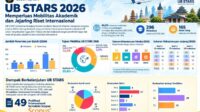

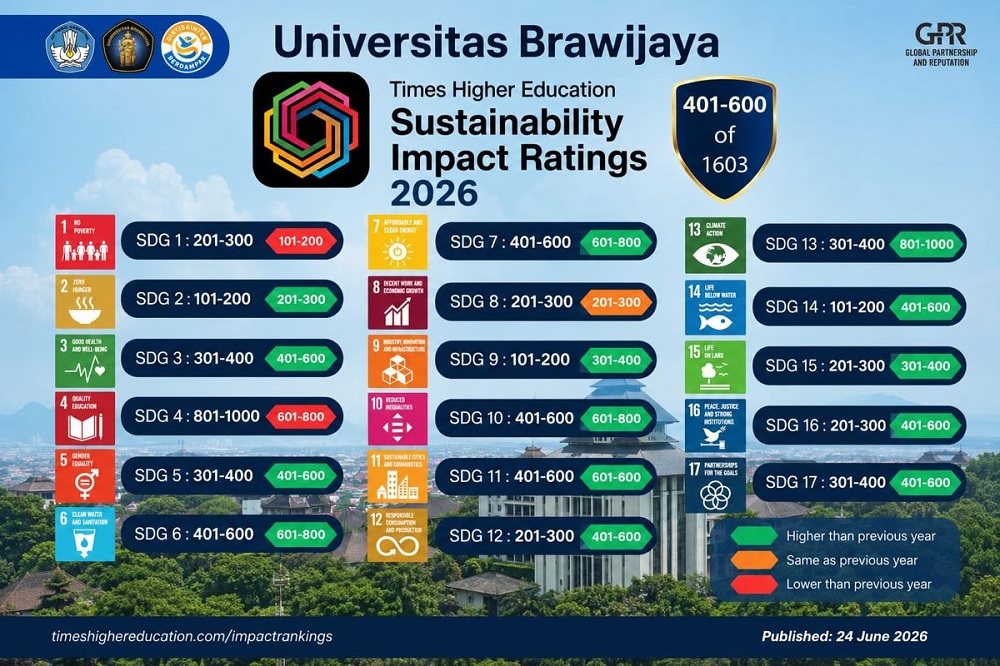
Malang, en.SERU.co.id – Universitas Brawijaya (UB) has once again demonstrated its strong commitment to sustainable development on the global stage. In the 2026 THE Sustainability Impact Ratings, the university improved its performance across 14 of the 17 Sustainable Development Goals (SDGs) assessed, while maintaining its overall position in the 401–600 band worldwide.
Hendrix Yulis Setyawan, PhD, Head of UB’s Global Partnership and Reputation Unit, described the results as a significant achievement, especially as more institutions join the ranking each year. This edition evaluated over 1,000 universities from around the world.
Notable Gains
UB posted strong improvements in several key areas, including:
- SDG 2 (Zero Hunger)
- SDG 3 (Good Health and Well-being)
- SDG 5 (Gender Equality)
- SDG 6 (Clean Water and Sanitation)
- SDG 7 (Affordable and Clean Energy)
- SDG 9 (Industry, Innovation and Infrastructure)
- SDG 10 (Reduced Inequalities)
- SDG 11 (Sustainable Cities and Communities)
- SDG 12 (Responsible Consumption and Production)
- SDG 13 (Climate Action)
- SDG 14 (Life Below Water)
- SDG 15 (Life on Land)
- SDG 16 (Peace, Justice and Strong Institutions)
- SDG 17 (Partnerships for the Goals)
Particularly impressive jumps were seen in SDG 9, which climbed from the 301–400 band in 2025 to 101–200 this year, and SDG 14 (Life Below Water), which made a similar leap from 401–600 to 101–200. SDG 13 (Climate Action) also surged from 801–1000 to 301–400, while SDG 12 and SDG 16 both advanced into the 201–300 range.
SDG 2 rose from 201–300 to 101–200, and SDG 3 improved from 401–600 to 301–400. Meanwhile, SDG 8 (Decent Work and Economic Growth) held steady in the 201–300 group.
Not all indicators moved forward. SDG 1 (No Poverty) and SDG 4 (Quality Education) saw declines compared to the previous year. According to Hendrix, the drop in SDG 1 was linked to fewer community empowerment programs focused on poverty alleviation. The decline in SDG 4 was influenced by metrics related to lifelong learning and a reduction in first-generation students.
Despite these setbacks, Hendrix views the overall results positively, noting that the majority of indicators improved and UB’s global standing remained stable amid growing competition.
Read Also:
FSTeM Universitas Brawijaya Sends 578 Students to 40 Villages in Malang for 2026 KKN
International Recognition
Vice Rector for Academic Affairs, Prof. Imam Santoso, said the results reflect growing international recognition of UB’s sustainability initiatives.
“Achieving gains across 14 SDGs is something to be proud of, especially in such a competitive global landscape. It shows that UB’s programs are making a real, acknowledged contribution to sustainable development worldwide,” Prof. Imam said.
To build on this momentum, UB plans to strengthen community empowerment efforts through its adopted villages, MSME mentoring, and innovation-driven economic development—particularly to boost performance on SDG 1.
The university also intends to expand lifelong learning opportunities through professional training, certifications, open courses, and other accessible education programs. Greater support for first-generation students via affirmative programs, scholarships, and outreach activities is also in the works.
This balanced approach underscores UB’s ongoing drive to align its academic and social missions with global sustainability targets. (aan/mzm)