

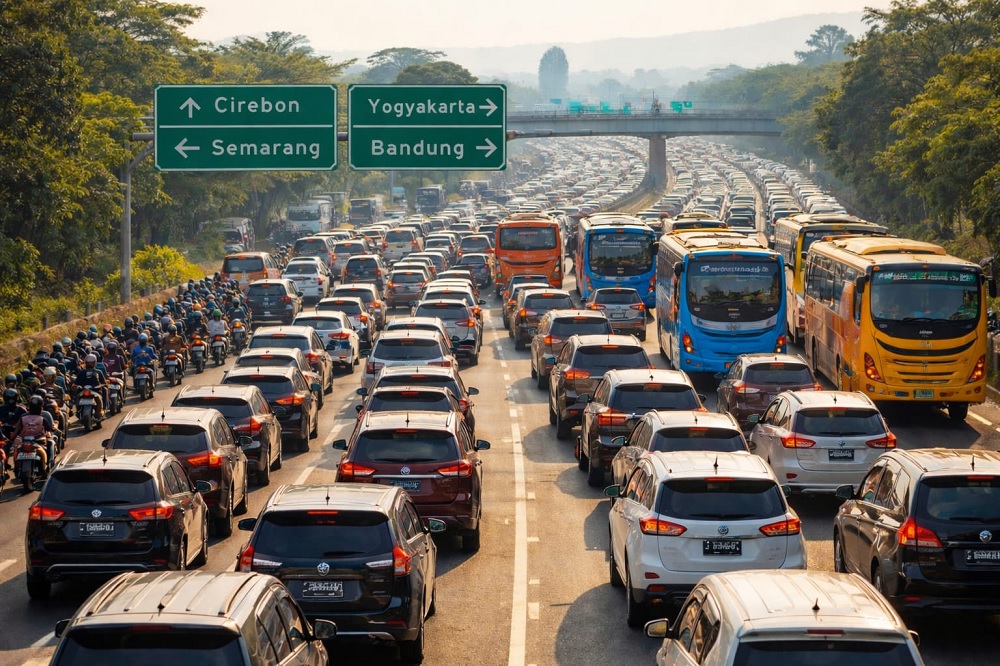
Jakarta, en.SERU.co.id – The Eid al-Fitr 2026 Homecoming Rush (Mudik Lebaran) is forecasted to involve approximately 143.9 million trips across Indonesia, based on surveys from the Ministry of Transportation (Kemenhub). This represents a slight decline of about 1.75% from the previous year’s survey figures, though actual numbers could rise as seen in past years where realizations exceeded projections. Peak congestion is expected in two main waves: March 14–15, 2026 (often tied to early holiday departures, such as school breaks) and March 18–19, 2026 (dominated by workers, including civil servants, state-owned enterprise employees, and private sector staff).
This massive mobility surge, driven largely by private vehicles, poses significant risks of severe traffic jams on toll roads, arterial routes, and port accesses. Private cars remain the preferred mode, with around 52% of travelers (about 76.24 million people) opting for them, and roughly 50.63 million expected to use major toll sections. Motorcycles account for a notable portion (around 8.65 million riders), often sticking to non-toll arterial or alternative paths.
Dominant Routes and Destinations
Movement patterns heavily favor eastern Java directions, with about 50% of the estimated 3.5 million vehicles heading eastward via key toll segments like Cipularang to Purbaleunyi (connecting to West and Central Java). Around 28% aim toward Merak for ferry crossings to Sumatra, while 20% target southern areas such as Bogor and surroundings.
Critical Congestion Hotspots on Java Island
Several locations are flagged as high-risk due to merging flows, lane reductions, rest area overloads, urban intersections, and non-toll bottlenecks:
- Trans-Java Toll Road:
- GT Cikampek Utama (main exit from Jakarta).
- KM 66 Jakarta–Cikampek (merging with Bandung flows from Purbaleunyi).
- KM 47–49 Jakarta–Cikampek (interaction with MBZ elevated road).
- KM 110 Jakarta–Cikampek (lane reduction from three to two).
- Rest Area KM 166 Cipali (overcrowding from stops).
- Dawuan Interchange (Cipali and Cipularang convergence).
- GT Kalikangkung, Semarang (gateway to Central Java).
- Jatingaleh area, Semarang (urban-toll merging).
- North Coast (Pantura) Route:
- Indramayu–Cirebon (traffic lights and market activity).
- Brebes–Tegal (urban density).
- Scattered “pasar tumpah” (spillover markets) slowing flows.
- Southern West Java Routes:
- Nagreg (key Bandung–Tasikmalaya link).
- Limbangan, Garut (narrow sections).
- Jomin–Cikopo intersection, Karawang (Pantura-toll merge).
- Tourist Areas:
- Ciawi–Simpang Gadog (Puncak, Bogor) – holiday leisure traffic spikes.
- Ciawi–Cibadak–Sukabumi (alternative route often overloaded).
- Central Java Arterial Roads:
- Semarang–Demak–Kudus (logistics and mudik overlap).
- Boyolali (Semarang–Solo junction).
- East Java:
- Simpang Empat Legundi, Gresik.
- Railway crossings (e.g., JPL 361 Gresik; west/east Lamongan).
- Tugu Wingko intersection, Lamongan.
High-Risk Congestion Points on Sumatra Island
Sumatra faces similar pressures, especially on east-west crossings and ferry ports:
- South Sumatra:
- East Cross Route (Jalintim) Palembang–Betung (narrowing and high volume).
- Functional toll exits (Kramasan–Pangkalan Balai) causing backups onto Jalintim.
- Tungkal Jaya, Musi Banyuasin.
- Central Cross Route (Jalinteng) – market spillovers and intersections.
- Lahat–Muara Enim (arterial slowdowns).
- Lampung:
- Bakauheni Port (ferry queues).
- Port buffer zones (pre-entry buildup).
- South Bakauheni Toll Gate (exit congestion).
- Bandar Lampung arterial intersections.
- Bakauheni–Terbanggi Besar Toll (accident-prone dense spots).
- West Sumatra:
- Anai Valley (narrow, steep climbs/turns).
- Sitinjau Lauik (extreme inclines).
- West Sumatra–Jambi border.
- Padang–Bukittinggi tourist corridors.
- Riau:
- Northern cross to Medan (high inflows from West Sumatra/Jambi).
- Western cross to Bukittinggi.
Recent Extreme Congestion Examples
Even before the absolute peak, severe jams have emerged:
- Bali’s Denpasar–Gilimanuk route saw queues of 45–50 km toward Gilimanuk Port, causing heat exhaustion (16 reported fainting cases).
- Sumatra’s Palembang–Jambi Jalintim stretch had 35 km tailbacks from broken trucks and wrong-way driving.
Government and Practical Mitigation Strategies
Authorities have mapped vulnerabilities and urge proactive measures:
- Understand peak departure patterns — Many favor post-Tarawih nights or post-Subuh mornings, creating synchronized surges.
- Monitor traffic engineering — Expect odd-even plates, one-way systems on tolls by police.
- Cross-check navigation apps — Use Google Maps alongside Waze for real-time optimal routes.
- Ensure sufficient e-toll balance — Low saldo often worsens gate backups.
- Plan flexible rests — If toll rest areas overflow, detour to mosques or eateries on arterials.
- Follow official updates — Check mudik.pu.go.id for live maps and conditions.
This period combines cultural tradition with logistical challenges, where early planning, vehicle checks, and staggered travel can significantly reduce risks. While numbers show a minor dip, the scale remains enormous, emphasizing safety, patience, and awareness of alternatives like public transport or staggered timing. (aan/rhd)