

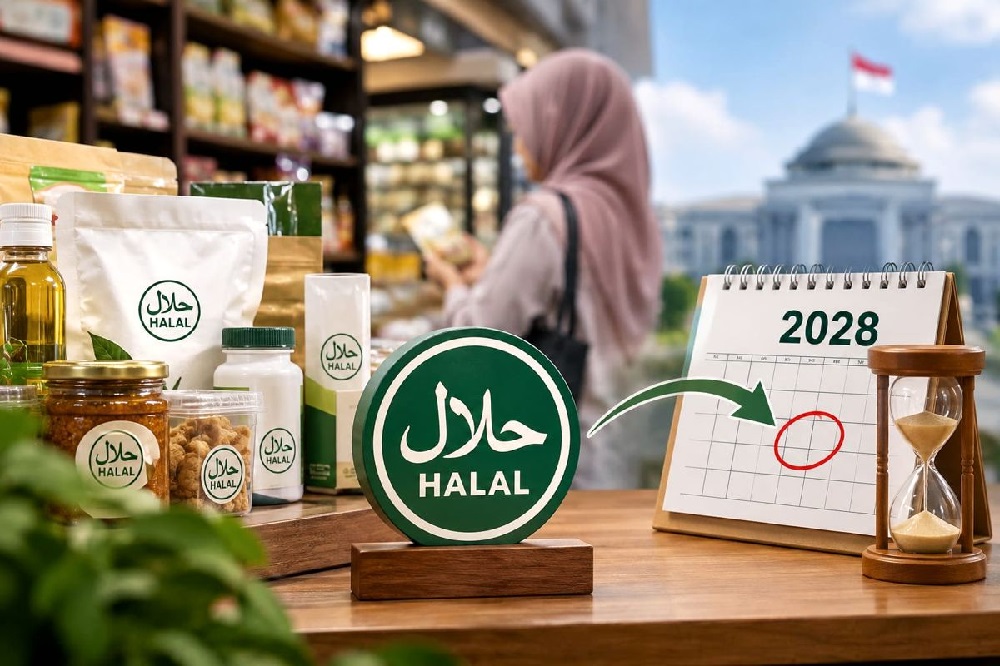
Jakarta, en.SERU.co.id – The Indonesian government has extended the phased introduction of mandatory halal certification for a range of products and services until 2028. Academics are urging authorities to use the extra two years for education and to build a genuine halal culture, warning that without concrete action another postponement could follow in 2028.
Secretary of the Coordinating Ministry for Economic Affairs Susiwijono Moegiarso said the extension will be formalized through a revision of Government Regulation No. 42 of 2024 on the Implementation of Halal Product Assurance. Previously, several certification obligations were scheduled to take effect on 18 October 2026.
“Schedule adjustments are needed so that the implementation of the halal certification obligation proceeds in line with the readiness of its supporting ecosystem,” Susiwijono said, as quoted by Kompas.com on Sunday (18/10/2026).
Under the amended Article 160, the obligation for services related to food, beverages, and slaughtered products—excluding slaughtering services themselves—will begin on 18 October 2028.
Micro and small enterprises (UMK) also receive an extension until 17 October 2028, particularly for food, beverages, slaughtered products, and slaughtering services.
The same 18 October 2028 start date applies to food, beverages, and slaughtered products from abroad, including slaughtering services. Officials said the adjustment also takes into account ongoing efforts to complete mutual recognition agreements on foreign halal certificates.
The extended timeline until 17 October 2028 covers several product categories previously due in 2026. These include natural medicines, quasi-medicines, health supplements, cosmetics, chemical products, and genetically engineered products.
Free and limited free medicines retain their original phased deadline of 17 October 2029. Hard drugs excluding psychotropics keep their timeline until 17 October 2034. Other product categories continue to follow the schedule set out in Government Regulation No. 42 of 2024.
The government will also adjust implementing rules and revoke BPJPH Regulation No. 4 of 2026, which governed the verification of foreign halal products entering Indonesia.
Read Also:
New East Java Police Chief Dekananto Eko Purwono Officially Begins Duties
Two Years to Build a Halal Culture
Responding to the extension, Professor A. Umar of UIN Walisongo Semarang, who also chairs the Education, Pesantren, and Ulama Cadre Commission of the Central Java MUI, said the extra two years must be filled with concrete steps.
“If we only use these two years to wait for the mandatory halal declaration, it is not impossible that October 2028 will end with the same story. Without adequate education, we will end up delaying it again,” he said, as reported on the Ministry of Religious Affairs website.
Instead, he argued, the 2028 deadline can become a moment to build public habits of choosing halal products while helping businesses prepare the required certificates.
The former head of BPJPH’s Development Center at the Ministry of Religious Affairs (2021–2022) stressed that two years is meaningful if used to plant awareness and cultivate the habit of consuming halal products. He called on the Ministry of Religious Affairs network to play a more active role through educational institutions and community activities.
“Madrasahs and Islamic boarding schools can start implementing a halal culture from their immediate environment. By providing halal-labeled products in canteens, kitchens, and student cooperatives,” he said.
Offices of Religious Affairs (KUA) could include guidance on choosing halal products in premarital counseling. Religious counselors could regularly raise the topic in study groups, while mosques could set an example through the food served at religious gatherings.
Beyond public education, Umar highlighted the need to prepare human resources to support certification. Islamic higher education institutions, he said, have an opportunity to train more halal auditors and supervisors.
“The key is consumer awareness, the readiness of business actors, the availability of accompanying personnel, and the support of educational and religious institutions,” he concluded. (aan/mzm)