

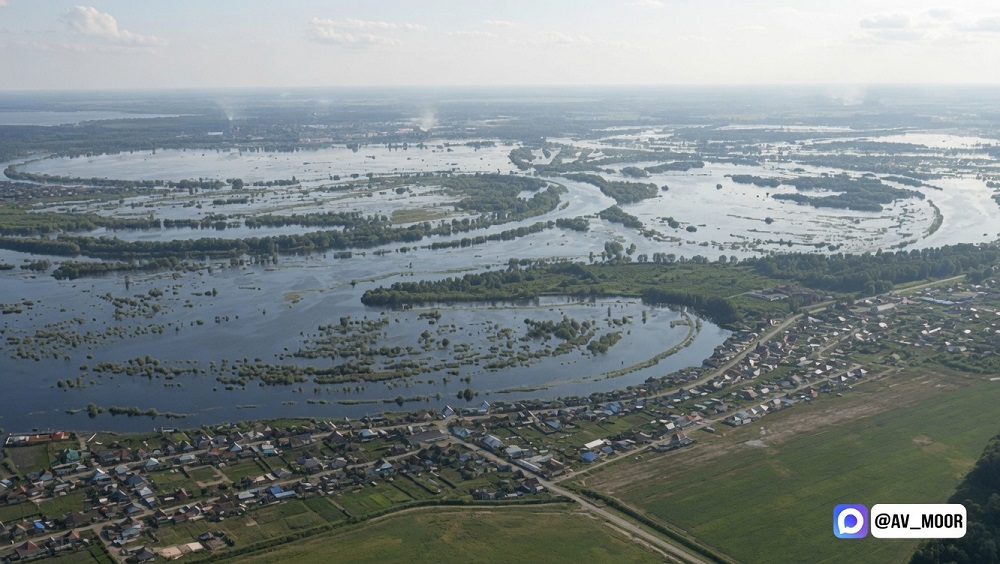
Tyumen, en.SERU.co.id – The Tura River in the Tyumen region of southwestern Russia continues to experience a significant rise in water levels due to an unusual summer flood. As of the morning of 28 July 2026, the latest official river level remained the measurement recorded on 27 July.
According to the latest official measurement, released through the Pavodok.Info bot and cited by local media, the Tura River reached 872 cm on 27 July—22 cm above the hazardous threshold of 850 cm.
Previously, on the morning of 26 July, the water level was recorded at 859 cm (+13 cm in 24 hours). Tyumen Mayor Maxim Afanasyev stated:
“Exceeding the critical mark of 850 cm means we are facing a dangerous phenomenon that requires intensified monitoring and prompt operational action from all city services. The highest recorded water level was 915 cm in 1979. High levels were also recorded in 1998 at 871 cm and in 2016 at 868 cm.”
Governor of the Tyumen Region Alexander Moor conducted an aerial inspection with local officials. He described the situation as highly serious. He wrote on his social media account:
“The Tura River is behaving very unusually this year… There’s a lot of water, the entire floodplain is submerged. Drawing on the experience we gained in Ishim in 2024, we are preparing for the most unfavorable scenario.”
Officials now expect the peak to occur between 28 and 31 July. Forecasts suggest water levels could climb to between 890 and 910 cm in the first days of August. Round-the-clock monitoring of dams and levees is under way. Sandbags and heavy equipment have been positioned at vulnerable points. Around 70 temporary shelters, with capacity for more than 30,000 people, have been prepared. Authorities have also begun pre-emptive evacuations of elderly and vulnerable residents from low-lying areas.
Read Also:
France and Spain Wildfires Force Over 200,000 Evacuations as Fires Threaten Bordeaux
Beyond the rising water, residents have also complained about sharply deteriorated water quality. Low dissolved oxygen levels earlier in the month led to significant fish kills. Many households also reported a strong smell of swamp and rotting organic matter in their tap water. Treatment plants are operating under emergency protocols. While officials maintain that the water remains safe from a microbiological standpoint, they continue to advise residents to boil it or use bottled supplies.
The current flooding has been driven by a rare combination of factors. These include record rainfall in June, reaching 257% of the monthly average, already saturated soil from a snowy winter and wet spring, and continued downpours across the Tyumen and neighboring Sverdlovsk regions.
As of early 28 July, no new official morning reading had yet been widely released. Local media reported that water levels were still rising. Authorities are urging residents to stay informed through official channels. These include the Pavodok.Info service and updates from the governor’s office and the city administration.