

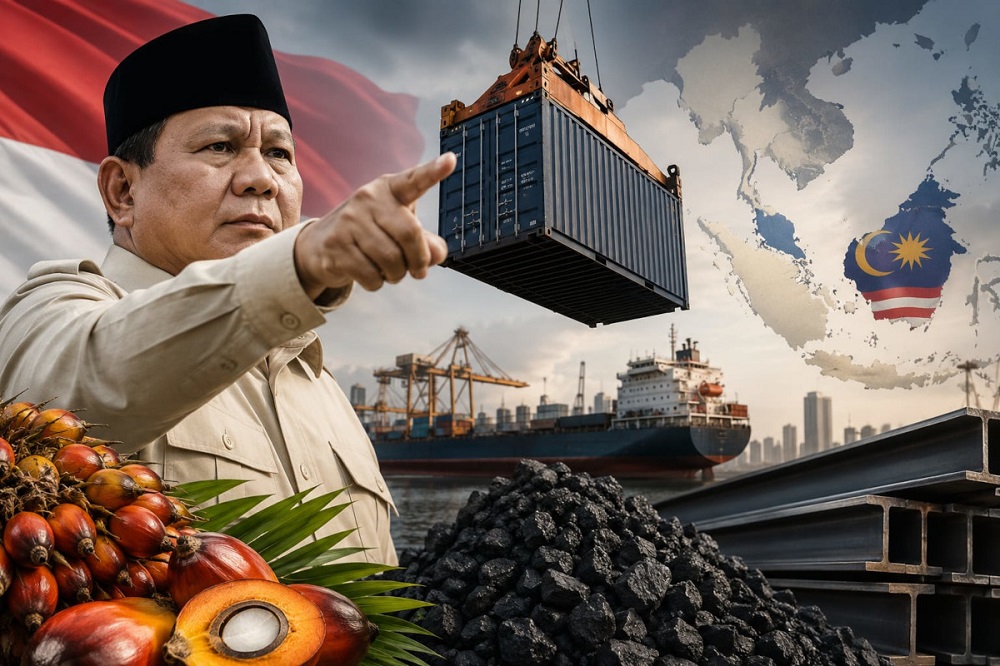
Jakarta, en.SERU.co.id — President Prabowo Subianto has officially rolled out a sweeping operation to tackle long-running manipulation in Indonesia’s natural resource exports, which are estimated to have cost the country up to Rp15,400 trillion ($908 billion) over more than three decades.
The centerpiece of the plan is the appointment of a state-owned enterprise under Danantara as the sole exporter for crude palm oil (CPO), coal, and iron alloys. The policy, set to roll out in phases starting June 1, 2026, aims to eliminate export mafia practices, particularly the hoarding of export earnings overseas.
Prabowo Exposes “Paper Games”
In a strongly worded statement, Prabowo highlighted under-invoicing and other document manipulation tactics that allowed exporters to understate volumes and values, reducing tax and foreign exchange obligations.
“For 34 years, what happened? Fraud on paper. For example, the volume of coal shipped is deliberately reported smaller in Indonesia’s export documents, but the data at the destination port shows a completely different number,” Prabowo said, as quoted by Kompas.com on Thursday (May 21, 2026).
These practices have resulted in massive revenue losses and kept a large portion of export earnings (DHE) parked abroad rather than flowing into the domestic financial system. To address this, the government is centralizing exports through PT Danantara Sumber Daya Indonesia (DSI).
Danantara’s One-Stop Export System
Danantara CEO Rosan Roeslani said PT DSI will serve as the government’s main instrument to drive export transaction manipulation down to zero.
The plan is divided into two major phases:
1. Phase 1 (June 1 – December 31, 2026): Oversight and Verification
DSI will act as an official verifier and intermediary for all export transactions. Existing exporters can continue operating, but every deal—including invoices and declared values—will fall under DSI supervision. This period is intended as a fine-tuning phase to avoid major disruption to global supply chains.
2. Phase 2 (Starting January 2027): Single Buyer Model
DSI will become the sole purchaser of these strategic commodities. Domestic producers will be required to sell CPO, coal, and iron alloys directly to DSI, which will then handle all international exports.
Read Also:
Prabowo’s Unity Call at NU’s Mujahadah Kubro: Leaders Must Harmonize for National Progress
Government Moves to Calm Market Jitters
Coordinating Minister for Economic Affairs Airlangga Hartarto sought to reassure businesses, emphasizing that existing exporters will not be shut down overnight.
“The government is still providing a transition period of several months before the system runs fully. All technical regulations will be completed before the first phase begins on June 1,” he said.
Palm Oil Industry Voices Concerns
Eddy Martono, Chairman of the Indonesian Palm Oil Entrepreneurs Association (GAPKI), warned that the government may be oversimplifying a complex business.
“Not all exporters are large integrated companies with their own plantations and downstream facilities. Many are pure traders who have built specific markets and networks over many years,” Martono said, as quoted by CNN Indonesia.
He expressed fears that the single-buyer model could kill off local traders and reduce the flexibility that has been a competitive advantage for Indonesian exporters. Global buyers often demand varied product specifications, volumes, and delivery arrangements that a single state institution may struggle to accommodate efficiently.
There are also concerns that the new system could create fresh monopolies, opening the door to new rent-seeking and added bureaucracy.
Malaysia Positioned to Gain
Amid the uncertainty, Malaysia is seen as the biggest potential beneficiary. Former Malaysian Palm Oil Association chairman MR Chandran noted that international buyers tend to avoid markets undergoing major regulatory overhauls.
“If the implementation of PT DSI is viewed as risky or unstable, some international contracts could temporarily shift to Malaysia. The global market is highly sensitive to supply certainty and speed of service,” he said.
The government maintains that the reforms are essential to protect state revenue and ensure export proceeds benefit the domestic economy. Implementation over the coming months will be closely watched by industry players and international markets alike. (aan/mzm)