
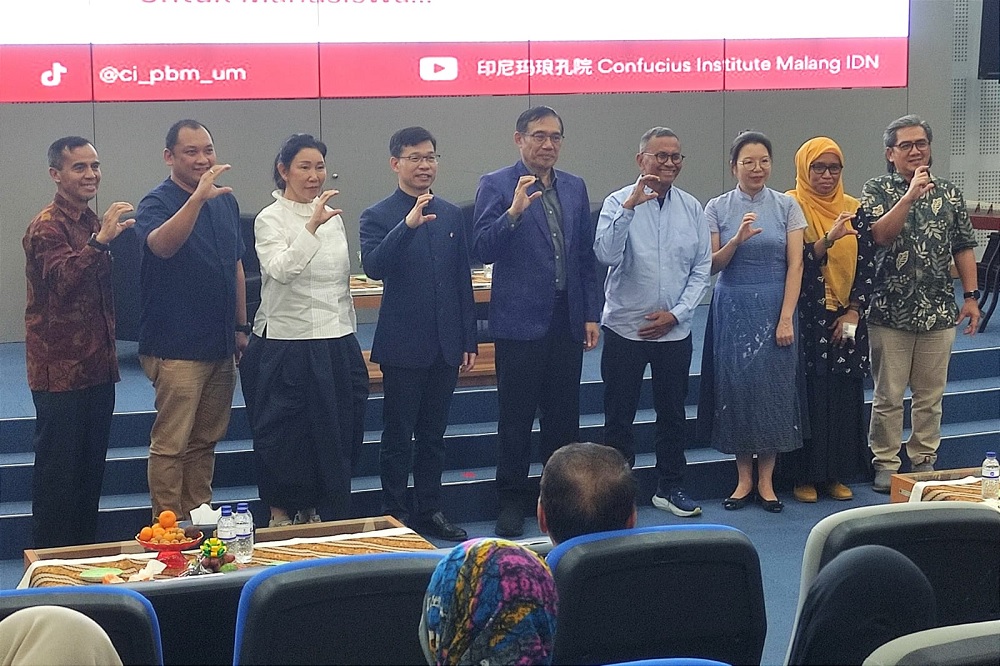
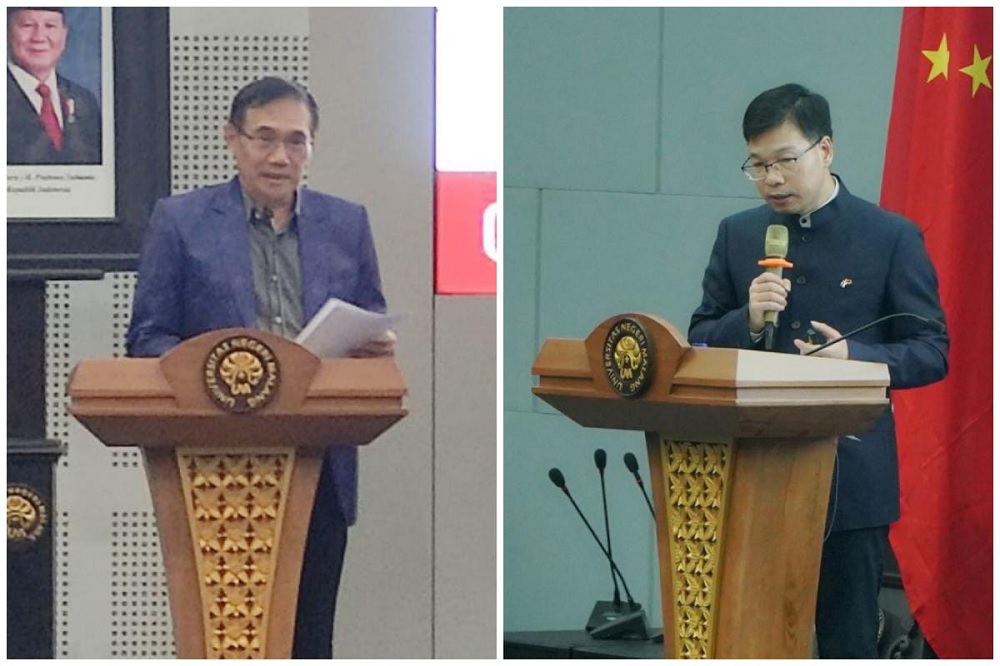
Malang, en.SERU.co.id – Universitas Negeri Malang (UM) served as host for the “Understanding Contemporary China” seminar held at the GKB A20 Auditorium, 9th floor, on Thursday evening, April 2, 2026. The event featured two distinguished speakers: Dr. Ye Su, Consul General of the People’s Republic of China (PRC) in Surabaya, and Prof. Dr. (HC) Dahlan Iskan. Together they explored the secrets behind China’s astonishing rise to become the world’s second-largest economy, just behind the United States.
UM Rector, Prof. Dr. Hariyono, M.Pd., emphasized that understanding modern China requires more than observing its current achievements. It demands a deep dive into the nation’s long historical roots that have shaped its national character — from a once-insignificant state to a near-superpower.
“China is not merely a country, but a great civilization built on a very strong historical foundation,” Prof. Hariyono stated in his opening remarks.
Shaping Students’ Global Perspective
According to the Rector, this knowledge serves as essential food for thought in forming students’ worldview on global dynamics and equips them to compete on the international stage.
“China’s global dominance is no accident. It is the result of long-term strategies executed with remarkable consistency,” he explained. “For the academic world, this understanding is a crucial foundation for reading the direction of global change and drawing lessons for Indonesia’s own development.”
He noted that cultural exchanges between Indonesia and China are not new. UM hopes to expand cooperation beyond culture to include language and history, especially given the significant Chinese community already living in Indonesia.
“Historically, both China and Indonesia suffered under Japanese occupation. One valuable philosophical lesson we can learn from the Chinese is this: never give up easily. Because if we surrender, we will become slaves,” he added.
The seminar also underscored UM’s strategic role as a bridge for international collaboration, aligning with the United Nations Sustainable Development Goals — particularly Goal 4 (Quality Education) and Goal 17 (Partnerships for the Goals).
“Through this forum, students are encouraged not only to be observers but to become active participants in global dynamics based on knowledge, culture, and innovation,” Prof. Hariyono concluded.
Two Miracles of China’s Development and the Secrets Behind Them
Dr. Ye Su delivered a presentation titled “Two Miracles of China’s Development and the Secrets Behind Them.” He stressed that China’s success stems from a development model carefully tailored to its national character, covering social systems, education, infrastructure, and poverty alleviation.
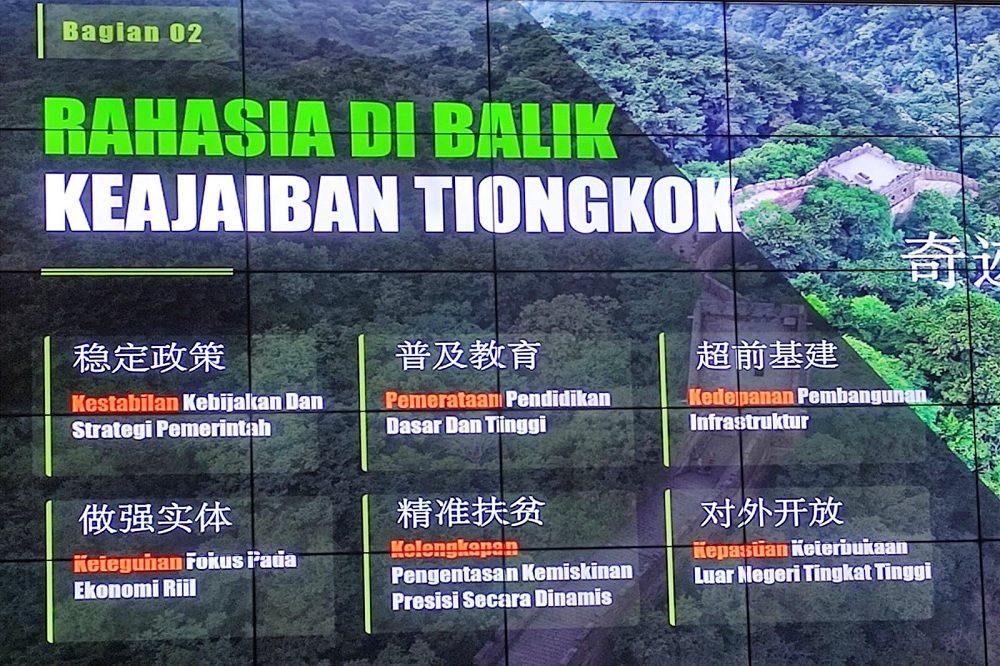
“China’s achievements come from two great miracles and the secrets behind them: rapid economic development and the six secrets that made the Chinese miracle possible,” Dr. Ye Su explained.
Miracle 1: Rapid Economic Growth
In 1978, China’s GDP stood at just US$0.15 trillion. By 2025, it had surged to US$19.6 trillion — a 130-fold increase in only 47 years. At the start of that period, China’s economy was roughly equal to India’s; today it ranks second only to the United States.
Miracle 2: The Six Secrets Behind China’s Success
Dr. Ye Su outlined six key factors:
- Policy Stability and Long-Term Government Strategy China combines long-term and short-term planning, allowing consistent, multi-fold progress across sectors.
- Universal Access to Basic and Higher Education Basic education is both a right and obligation for school-age children. The goal is for the current generation to complete at least a master’s-level education and produce innovations that benefit the entire world. UM continues to strengthen ties with Chinese institutions through student exchange programs and cultural collaboration. Scholarships via the China Scholarship Council (CSC) are also available for Indonesian students. A notable example is the partnership with Guangxi Normal University, which established the Duxiu Shuyuan reading room at UM’s library, providing global literacy resources and deeper insight into China’s development.
- Massive Infrastructure Development China has created its own concepts tailored to national needs in technology and infrastructure. Many of these innovations are now adopted by other countries, including Indonesia.
- Strong Focus on the Real Economy The Jakarta–Bandung High-Speed Railway (Whoosh) was highlighted as a concrete symbol of strategic Indonesia–China cooperation that accelerates connectivity and drives national economic growth. “The Whoosh project can be seen as a miniature model of China–Indonesia collaboration in promoting development and connectivity,” Dr. Ye Su noted.
- Precision and Dynamic Poverty Eradication The government provides health guarantees, skills training, and welfare support, with the target that every family should be able to help at least one other family.
- High-Level Openness to the Outside World China actively shares its development experience and technologies — such as AI, electric vehicles, electric motorcycles, and robotics — with countries in need. “China is willing to share its development experience and inspire other nations to find their own path toward shared prosperity,” he said.
Insights from Prof. Dr. (HC) Dahlan Iskan
Prof. Dr. (HC) Dahlan Iskan presented under the theme “Lessons from China,” drawing from his own books. He attributed China’s success to its exceptionally long period of political and policy stability.
“While Indonesia previously used five-year Repelita development plans, China plans on a much longer horizon. They combine long-term and short-term strategies dynamically, always adjusting to the needs of the times,” said the former State-Owned Enterprises Minister.
Prof. Dahlan Iskan also highlighted the urgent need for Indonesia to prepare its human resources as more Chinese companies enter the country. He stressed that Mandarin language skills represent a significant competitive advantage in the job market.
“Many Chinese companies operating in Indonesia are actively seeking local workers who can speak Mandarin. This is a huge opportunity for students if they start preparing now,” he emphasized. (rhd)