

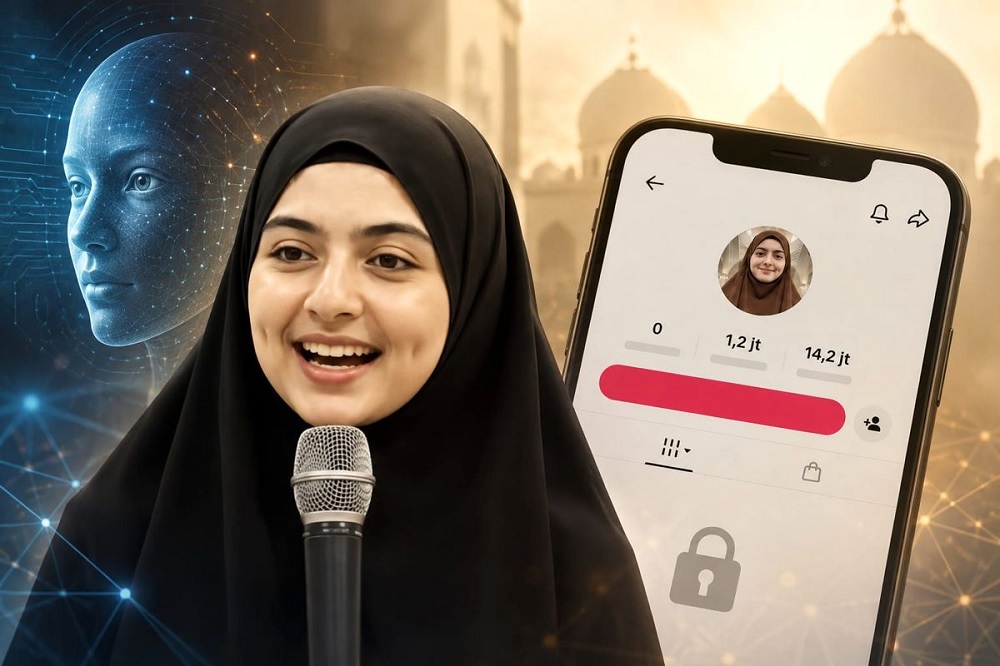
Jakarta, en.SERU.co.id — The rise of “Ustazah Nia Hajar,” a popular TikTok figure delivering calm, convincing Islamic lectures, has triggered widespread discussion among digital experts, academics, religious authorities, and the Indonesian Ministry of Religious Affairs. The catch? She isn’t real — she’s an AI creation.
The account @nia.hajar_s amassed more than 1.2 million followers and 14.2 million likes by Thursday, July 9, 2026, before it was switched to private. In her videos, the hijab-wearing persona appears indistinguishable from a human ustazah, speaking with a serene and authoritative tone.
Hard to Tell Apart from Humans
Culture and digital communications observer Firman Kurniawan confirmed the figure is AI-generated, pointing to telltale signs like unnaturally flawless intonation and perfectly consistent pacing with almost no natural pauses for thought.
“AI voices tend to be too polished. The technology is now cheaper and easier for anyone to use, while the output looks and sounds increasingly realistic. That combination is driving massive adoption in digital content creation,” he said.
Digital security analyst Alfons Tanujaya noted that AI-generated virtual characters can attract even larger audiences than real human creators. The real issue, he said, is accountability.
“The problem isn’t the technology itself, but who controls it. If we don’t know who’s behind the account, it becomes very difficult to hold anyone responsible when content turns misleading, manipulative, or even illegal,” Tanujaya explained.
A New Chapter in Digital Preaching
Dr. Badrah Uyuni, Secretary of the Doctoral Program in Da’wah Studies at Universitas Islam As-Syafi’iyah and a member of the MUI Fatwa Commission for DKI Jakarta, sees the phenomenon as a milestone in digital Islamic outreach.
“Da’wah has evolved from the pulpit to radio, TV, YouTube, and now TikTok. AI is emerging as a new communicator that can speak and interact like a real preacher,” she said.
Uyuni emphasized that Islam does not automatically prohibit AI, viewing technology as neutral. The key questions are how it’s used, by whom, and for what purpose.
“AI has huge potential to make da’wah more engaging, faster, and accessible — especially to younger generations,” she added. However, it lacks a proper chain of knowledge (sanad), has never studied under real teachers, and carries no moral responsibility for its teachings.
She warned of a potential crisis of religious authority, where social media popularity could overshadow genuine scholarly expertise. At the same time, she said the trend should push real preachers to make their messages more authentic, academically sound, and digitally relevant.
Read Also:
Apple Can No Longer Avoid Price Hikes Due to AI Chip Shortage
Ministry: AI Is a Tool, not a Replacement
The Ministry of Religious Affairs echoed similar caution. Thobib Al-Asyhar, Head of the Bureau of Public Relations, Data, and Information, said the emergence of AI preachers shows how deeply digital technology has entered religious spaces.
“Any material from AI must still be verified by competent scholars,” he stated. In Islamic tradition, a preacher carries a prophetic responsibility that requires clear scholarly lineage and proper learning.
Thobib stressed that AI should never become the primary source for understanding religion, as it lacks real learning experience, moral authority, or personal accountability.
The ministry urged the public to treat AI as a helpful learning aid — not a substitute for qualified ulama, kiai, ustaz, or ustazah with proven expertise and track records. (aan/rhd)