
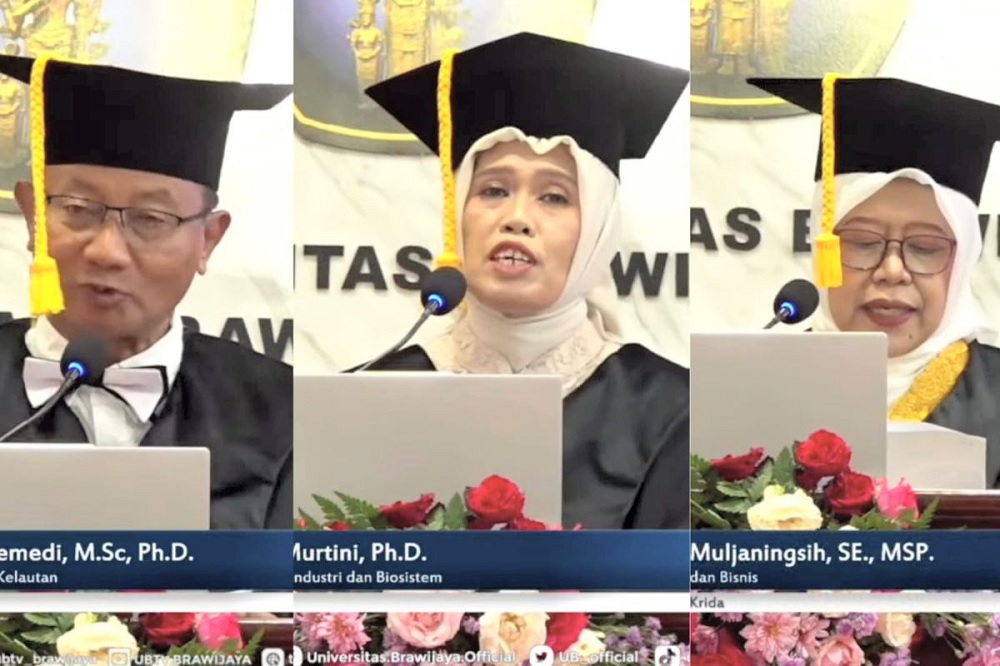
Malang. en.SERU.co.id — Universitas Brawijaya (UB) has appointed three new professors across different disciplines, bringing fresh ideas to tackle challenges in fisheries and local community-based economic development.
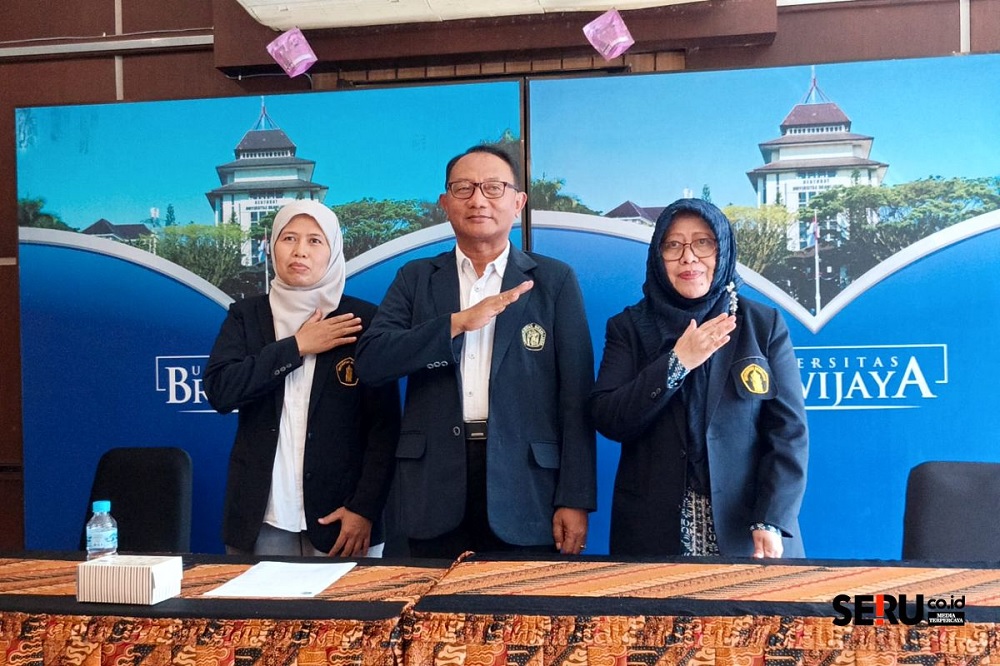
The professors were officially inaugurated by UB Rector on Wednesday (10/6/2026). Here are the new professors and the innovations they presented:
Prof. Ir. Bambang Semedi, M.Sc., Ph.D.: MARINESCAPE Helps Fishermen Adapt to Climate Change
Prof. Bambang Semedi, from the Faculty of Fisheries and Marine Sciences (FPIK), introduced MARINESCAPE (Marine Intelligence System for Spatio-Temporal Catch Prediction) during his scientific oration.
The system uses satellite remote sensing and artificial intelligence, including machine learning and deep learning, to accurately predict potential fishing zones.
“Climate change has altered sea surface temperatures and ocean currents, making it much harder to predict the movement of economically valuable fish like skipjack tuna. This has increased operational costs and risks for fishermen,” Prof. Bambang explained.
MARINESCAPE aims to change that by providing real-time, data-driven support for decision-making, helping fishermen respond faster and more effectively to shifting marine conditions and ultimately boosting their incomes.
Prof. Erni Sofia Murtini, S.TP., M.P., Ph.D.: Pushing Diversification of Local Cereal-Based Foods
From the Faculty of Agroindustrial Technology and Biosystem (FTAB), Prof. Erni Sofia Murtini focused on strengthening national food security through greater use of local cereals and the preservation of traditional Indonesian foods.
She highlighted Indonesia’s heavy reliance on rice and wheat as a key challenge, noting that the country has many underutilized local food sources.
One promising option is sorghum, which can thrive on less fertile land. Prof. Erni also pointed to the global rise in demand for gluten-free products as a market opportunity for local cereals.
“Utilizing local cereals can reduce our dependence on imported raw materials. What we need is innovation and modernization that doesn’t erase the cultural value of traditional foods, so they remain appealing to younger generations,” she said.
The appointments reflect UB’s ongoing commitment to producing research that addresses real-world problems, from ocean sustainability to food sovereignty.
Read Also:
Brawijaya Career Expo 2026 Connects Graduates with 54 Companies in Malang
Prof. Dr. Sri Muljaningsih, S.E., M.S.P.: LILY Model Strengthens Community-Based Economy
Prof. Sri Muljaningsih, from the Faculty of Economics and Business (FEB), introduced the LILY Model (Local Integrated Livelihood Yield). The approach centers on community-driven circular economy principles to create added value from local resources.
The model combines entrepreneurship, community participation, and spirituality to turn local potentials into sustainable economic opportunities, particularly for small and medium enterprises (SMEs) and local communities.
“Model LILY puts the community at the heart of value creation. This way, economic benefits can be felt more broadly and sustainably,” she said.
Prof. Sri believes the model can strengthen local economies and generate new jobs by encouraging entrepreneurship rooted in sustainable natural resource use.
One example she highlighted is the development of salak Suwaru (a local snake fruit variety). The initiative goes beyond basic cultivation by empowering local farmers to diversify into processed products with higher market value.
With the inauguration of these three professors, Universitas Brawijaya continues to strengthen its academic capacity while delivering practical innovations to address pressing issues such as climate change, food security, and sustainable economic development in Indonesia. (bas/mzm)