

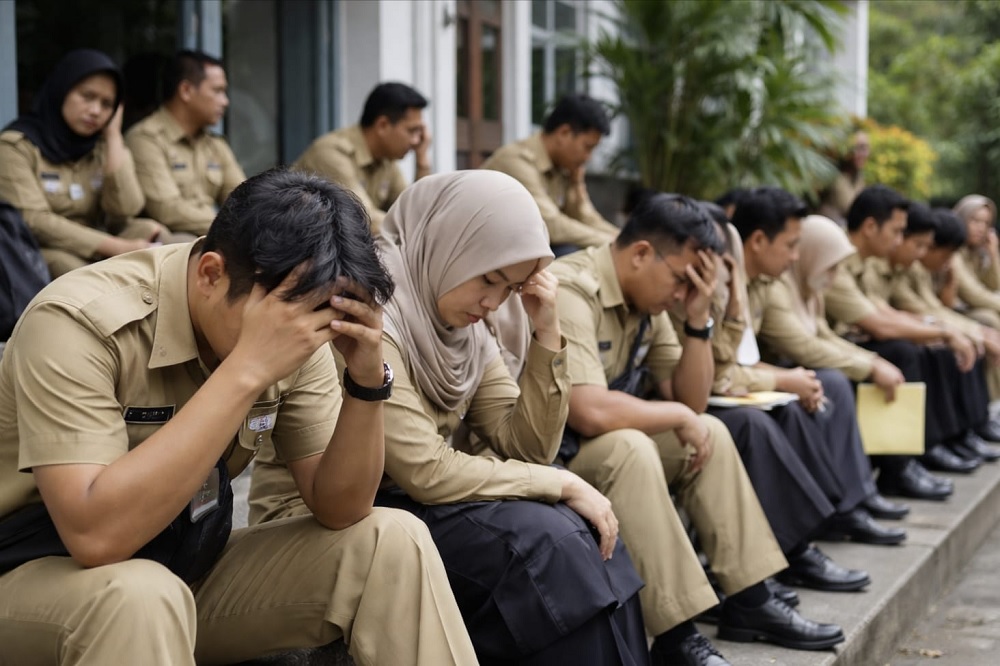
Jakarta, en.SERU.co.id – The policy restricting employee expenditure under Law No. 1 of 2022 on Financial Relations between the Central Government and Regional Governments (UU HKPD) is triggering growing alarm across Indonesia. The regulation, which caps employee spending at a maximum of 30% of the Regional Budget (APBD), is increasingly viewed as a ticking time bomb that could lead to the dismissal of thousands of Government Contract Workers (PPPK) by 2027.
Regional governments are now urged to aggressively increase Local Own-Source Revenue (PAD), restructure spending patterns, and improve the productivity of civil servants to mitigate the impact.
What is UU HKPD?
UU HKPD is a major regulatory reform signed into law on January 5, 2022. The law replaces two previous regulations considered outdated: Law No. 33 of 2004 and Law No. 28 of 2009.
According to the Supreme Audit Agency (BPK RI), the primary focus of UU HKPD is to improve the quality of regional spending and promote fiscal independence through optimization of Local Own-Source Revenue (PAD). One of its most critical provisions is the limitation of employee expenditure to a maximum of 30% of total APBD, excluding teacher professional allowances funded by the central government.
The central government has provided a five-year transition period, meaning all regions must fully comply no later than 2027.
The Purpose Behind the 30% Cap
This policy is not without reason. The central government aims to shift the long-standing pattern of regional budgets that have been heavily dominated by routine bureaucratic spending.
By enforcing the 30% limit, the government hopes to achieve the following:
- Reallocate more funds toward infrastructure development and public services
- Create a healthier and more productive APBD structure
- Reduce regional dependence on central government transfer funds
A Real Threat to PPPK Workers
Currently, many regional governments already exceed the 30% threshold, with employee spending reaching 40–50% of their APBD. This situation forces them to implement massive efficiency measures within a very limited timeframe.
In West Sulawesi, for example, employee expenditure currently stands at around 34–35%, equivalent to more than Rp600 billion. Ideally, this figure must be reduced to approximately Rp500 billion to meet the new regulation.
This pressure makes PPPK the most vulnerable group. Unlike permanent civil servants (PNS), PPPK are employed under contract agreements, making them easier to reduce or not renew.
Plans to cut PPPK positions have already surfaced in West Sulawesi and East Nusa Tenggara (NTT). In West Sulawesi, as many as 2,000 PPPK are at risk of dismissal in 2027. In East Nusa Tenggara, approximately 9,000 PPPK face termination to save hundreds of billions of rupiah in the budget.
Increasing PAD is the Key
Amid this pressure, boosting Local Own-Source Revenue (PAD) has become the main solution. Regional leaders essentially have two options: cut employee spending or significantly increase revenue.
“If West Sulawesi’s PAD can reach Rp1 trillion, then there will be no need to lay off PPPK,” said West Sulawesi Governor Suhardi Duka.
Central Government Sanctions Loom
UU HKPD takes enforcement seriously. Regions that fail to meet the 30% employee spending limit by 2027 risk facing strict sanctions, including:
- Delay or suspension of central government transfer funds
- Reduction in General Allocation Funds (DAU)
- Restrictions on appointing new employees (aan/rhd)