

Malang, en.SERU.co.id – The Faculty of Science, Technology, and Mathematics (FSTeM) at Universitas Brawijaya (UB) has adopted Japan’s School and Town Watching method for disaster mitigation education. The initiative aims to teach kindergarten students about disaster preparedness through the Universitas Brawijaya Campus Ring Community (Kampung Lingkar Kampus/KLK UB) program.
FSTeM Dean Prof. Sukir Maryanto said the School and Town Watching approach is designed to provide disaster education progressively, starting from kindergarten students to the general public living around the UB campus.
“We have programs and personnel dedicated to disaster-related activities. Therefore, we want to educate the academic community and broader society to foster a culture of disaster awareness across all levels,” Prof. Sukir said.
The 2026 Kampung Lingkar Kampus program is part of UB’s community service initiative. Carrying the theme Disaster Education for Early Childhood and Stakeholders, the program targets Cempaka Kindergarten in Ketawanggede and adopts Japan’s School and Town Watching approach.
The activities included:
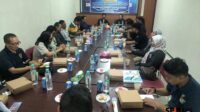
- Signing a memorandum of understanding (MoU) between FSTeM and Cempaka Kindergarten, which is part of Ketawanggede Village.
- Providing educational materials on earthquake disaster mitigation.
- Conducting earthquake disaster simulations involving FSTeM students and Cempaka Kindergarten children.
- Introducing volcanic eruption simulations through educational games.
UB’s Kampung Lingkar Kampus Program Involves the Entire Academic Community
Sukir said the KLK UB program was designed to involve the entire academic community and stakeholders to ensure FSTeM’s presence delivers tangible benefits to surrounding residents. Participants include faculty leadership, community service program coordinators, administrative staff, and students.
“The School and Town Watching method emphasizes direct observation of potential threats in the surrounding environment, tailored to the characteristics of each region,” Sukir added.
For areas surrounding the campus, such as Ketawanggede, the educational materials focus on relevant risks, including potential fires, building vulnerabilities, traffic congestion, flooding, and earthquake preparedness.
“For early childhood education, the approach is presented interactively through simulations and games to make it easier for children to understand. This time, we invited students from Cempaka Kindergarten in Ketawanggede,” he explained.
Introducing Disaster Mitigation at an Early Age
Sukir said introducing disaster mitigation at an early age can help develop children’s ability to respond more effectively to emergency situations. Through knowledge, visual concepts, and role-playing, children are encouraged to follow safety procedures without panicking.
“Disaster risk awareness must be developed from childhood so that children understand their surroundings, recognize potential threats, and know how to protect themselves. In this way, preparedness becomes not just knowledge but also a habit in everyday life,” said the professor of volcanology and geothermal science.
Similar Approach Previously Implemented Through MBKM and PKKM
A similar approach had previously been implemented through the Merdeka Belajar Kampus Merdeka (MBKM) program and the Kampus Merdeka Competition Program (PKKM) in areas affected by the Mount Semeru eruption in 2021–2022.
“Disaster education and assistance helped raise public awareness, allowing evacuations to proceed more quickly and orderly when the eruption occurred again in 2022,” he recalled.
Disaster Mitigation as the First KLK UB Pilot Project
As the first pilot project in UB’s campus-ring community, the disaster mitigation initiative is still in its early stages, with its implementation format undergoing development and refinement. This includes coordination across university units and exploring future funding support and collaboration.
The program’s continuation and expansion to higher education levels or other regions will depend on available funding schemes and partnerships.
“The main goal is to increase FSTeM’s impact through activities carried out progressively, from kindergarten to elementary school, junior high school, senior high school, and the communities surrounding the campus. All activities are based on budgeting, and since we have funding from the campus-ring community grant program, we are implementing it in Ketawanggede,” Sukir said.
Read Also:
UB Experts Warn of Risks in Proposed Javan Rhino Relocation to Alas Purwo
Method May Be Presented at a Global Disaster Forum
Beyond implementation around the campus and in supported areas such as Semeru, Sukir said the method could potentially be presented at a global disaster-related forum next year, as FSTeM UB seeks to expand the impact of its disaster research and community service initiatives.
“We will evaluate the program, make improvements, and further develop it to make the activities more impactful and extensive. Since we will be hosting a global disaster-related forum next year, we may include this method as one of the approaches presented at the forum,” he concluded.
Cempaka Kindergarten in Malang Welcomes the Initiative
Cempaka Kindergarten principal Nuraini Susanti expressed her appreciation for FSTeM UB’s initiative in providing disaster mitigation education to students. She said the materials offered valuable knowledge and experiences that children could carry with them into adulthood.
“Thank you to FSTeM for the opportunity and disaster mitigation education provided to our children. Although they have previously been introduced to disaster-related topics at Cempaka Kindergarten, FSTeM UB’s materials were different and presented in a more engaging way. We hope the children can absorb the lessons more effectively,” Nuraini said. (rhd)