
Malang, en.SERU.co.id — The spate of extreme weather events hitting Malang Raya in recent days is part of the seasonal transition period, or pancaroba, the Meteorology, Climatology, and Geophysics Agency (BMKG) said Friday.
The agency forecasts that the dry season across most of the region will begin in early May 2026, though some eastern areas bordering Lumajang are expected to enter it slightly later.
Anung Suprayitno, head of BMKG’s East Java Climatology Station, explained that the transition phase is already underway and is being marked by a surge in cumulonimbus cloud activity.
“During this current seasonal transition period, the appearance of cumulonimbus clouds is the key indicator,” Anung told reporters on Friday (April 10).
“These clouds usually form after a hot morning. By afternoon, white cauliflower-shaped clouds develop and then darken rapidly,” he added.
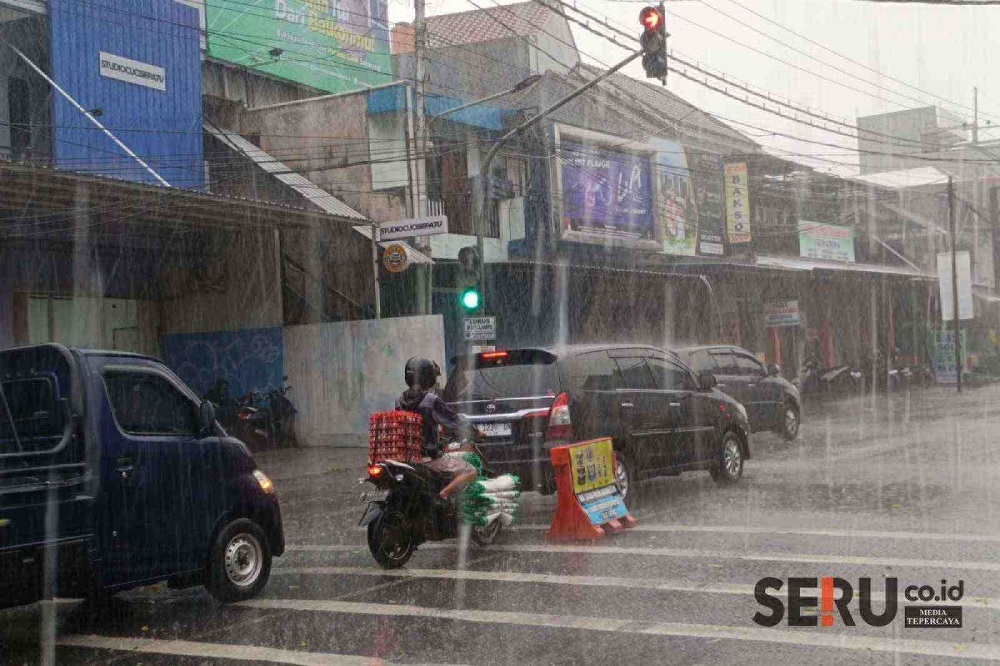
He warned that cumulonimbus clouds can trigger intense weather phenomena, including heavy downpours, hail, tornadoes (locally known as puting beliung), and thunderstorms. Both the intensity and frequency of such events typically rise during the pancaroba, with storms potentially affecting wider areas than usual.
“Tornadoes are not limited to specific locations. As long as a cumulonimbus cloud track passes overhead, they can occur anywhere — including in urban areas like Malang City,” Anung explained.
The extreme weather tends to be short-lived, he added. Heavy rain usually falls in brief but intense bursts, most often between midday and late afternoon or early evening.
Anung noted that occasional rain during the lead-up to the dry season is normal. A region is officially considered to have entered the dry season when monthly rainfall drops below 150 millimeters, even if isolated showers continue.
For the agriculture sector, BMKG has prepared an annual water allocation plan aligned with the cropping calendar. However, the schedule could be adjusted if climate anomalies arise.
The agency is also monitoring a predicted weak El Niño event expected to develop by mid-2026. If the phenomenon strengthens to moderate or strong levels, the dry season could last longer and the onset of the next rainy season could be delayed — possibly until early 2027 in some parts of the region.
To mitigate risks, BMKG and the East Java Provincial Government have coordinated on several preparedness measures. These include mapping drought-prone areas and forest fire hotspots, as well as exploring weather modification techniques to maintain water levels in key reservoirs such as Sutami Dam.
“During a recent coordination meeting with the East Java governor, we discussed options for weather modification to secure water supplies,” he said.
“We will continue to work closely with local governments to minimize the impacts of El Niño on water availability and prevent secondary disasters,” Anung concluded. (bas/rhd)