
Malang, en.SERU.co.id – Universitas Negeri Malang (UM) has developed D-ACT ECO, a digital economics learning medium based on Deep Learning and TPACK for Madrasah Aliyah. The platform encourages students to think critically, solve problems, collaborate and reflect. Validation results show D-ACT ECO received an Aiken’s V score above 0.80, placing it in the highly valid category.
The innovation was developed through research activities in July–August 2026 by integrating the Deep Learning approach and the Technological Pedagogical Content Knowledge (TPACK) framework. The development aims to foster students’ critical thinking, problem-solving, reflection and collaboration skills.
Lecturer at the Department of Development Economics, Faculty of Economics and Business (FEB) UM, Dian Rachmawati SE MPd PhD, explained that many teachers already use technology in economics lessons. However, its use is still not fully directed toward building deeper learning activities.
“The use of technology still tends to be limited to presentation media or document sharing. In fact, technology can be used to encourage students to think critically, solve problems, collaborate and carry out reflection,” said Dian, quoted from the UM website on Friday (11/9/2026).
This condition became one of the bases for developing D-ACT ECO. Based on a needs analysis conducted with economics teachers who are members of the East Java MA Economics MGMP, a need was found for a platform that does not only provide digital materials but can also integrate learning activities in a more meaningful way.
Another lecturer, Sri Handayani SPd MPd PhD, said D-ACT ECO was designed with attention to teachers’ needs and the characteristics of Madrasah Aliyah students.
“Teachers need a flexible, interactive and easy-to-use platform that can be accessed through various devices while still matching learning needs,” she said.
Not Just a Place to Store Materials
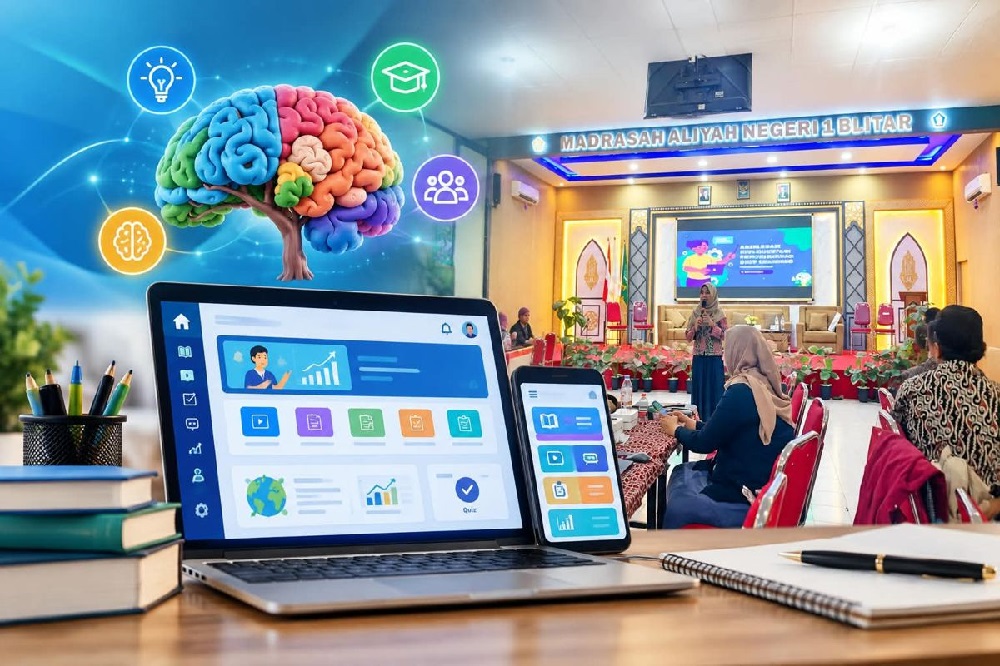
D-ACT ECO was developed as a digital economics learning ecosystem. The platform does not only function as a storage place for teaching materials. It also provides space for students to explore economic issues and carry out reflection.
Several features that have been developed include Dashboard, Learning Materials, Learning Videos, Digital Student Worksheets (LKPD), Discussion Forum, Quiz and Evaluation, Project Based Assignment, Learning Analytics and Teacher Dashboard.
Through these features, students are guided to connect economic concepts with issues they encounter in daily life. Learning activities are designed through a process of problem exploration, investigation, collaboration, reflection and knowledge transfer.
In the same vein, Ro’ufah Inayati SPd MPd explained that the integration of Deep Learning in D-ACT ECO is applied through three main principles: Meaningful Learning, Mindful Learning and Joyful Learning.
“Meaningful Learning helps students connect economic concepts with relevant experiences and issues. Meanwhile, Mindful Learning encourages conscious involvement in the learning process and reflection. Joyful Learning creates an engaging learning experience without reducing the depth of the material,” she explained.
Read Also:
Universitas Negeri Malang Climbs to 11th in Indonesia on Webometrics July 2026 Ranking
Tested Together with Economics Teachers
The development of D-ACT ECO used the Research and Development (R&D) method with the ADDIE model, which includes Analysis, Design, Development, Implementation and Evaluation.
In the analysis stage, the team identified learning needs through observation and interviews with the East Java Province MA Economics MGMP. Next, the design stage focused on preparing the platform structure, Deep Learning instructional syntax, TPACK integration and development instruments.
The prototype was then developed and validated before being applied in testing with teachers. The testing activities were carried out through collaboration with the Kediri Regency MA Economics MGMP and the Blitar MA Economics MGMP.
Teachers provided feedback on ease of use and the potential application of the platform in economics learning. The input from teachers was then used to refine the features and content of D-ACT ECO.
Validation Reaches Highly Valid Category
In the development stage, the D-ACT ECO prototype also went through validation by learning media experts, economics content experts and TPACK experts. This covered the interface appearance, navigation, ease of use, material quality, suitability with learning outcomes, Deep Learning implementation and TPACK integration.
Validation results showed that all aspects received an Aiken’s V score above 0.80. Therefore, the D-ACT ECO prototype is categorized as highly valid. According to Dian, these results show that the development of digital learning media is not enough if it relies only on technological aspects.
“Technology must have a connection with pedagogy and the material being taught. That is why D-ACT ECO was developed by ensuring these three aspects run in an integrated way,” she said.
Going forward, the development of D-ACT ECO remains open to expansion with more adaptive technology. The development team is considering the addition of Artificial Intelligence (AI), as well as personalized learning recommendations, adaptive question banks, gamification and a comprehensive analytics dashboard.
This further development is expected to make D-ACT ECO not only a medium for delivering materials but also a tool that helps teachers make learning decisions based on students’ learning progress. (aan/mzm)
Indonesian Version:
UM Kembangkan D-ACT ECO Berbasis Deep Learning untuk Penguatan Pembelajaran Ekonomi