

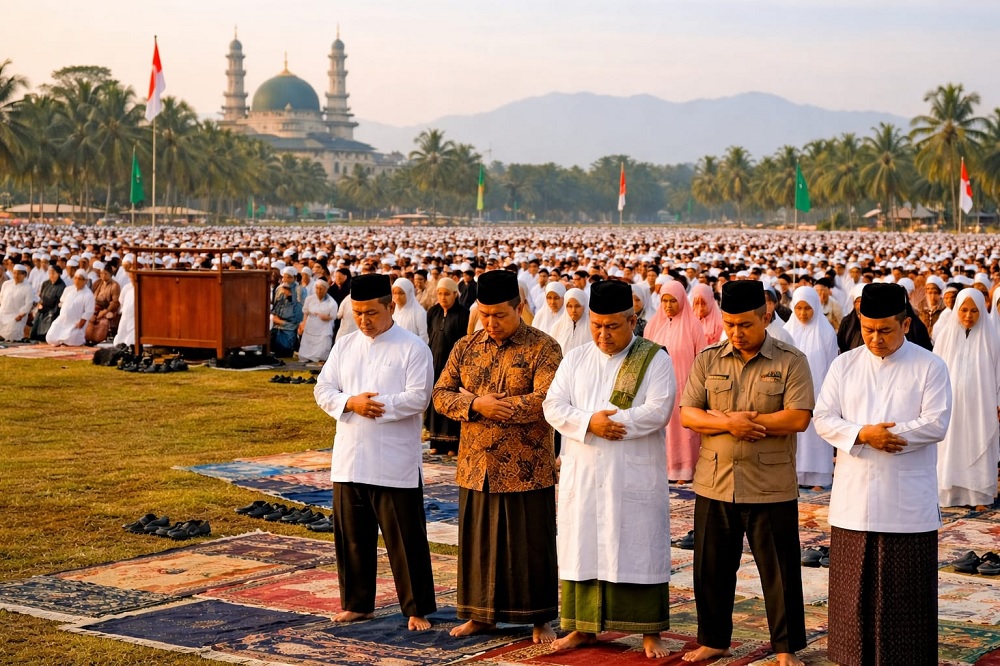
Jakarta, en.SERU.co.id – In Indonesia, the determination of Eid al-Fitr (Idulfitri) often varies due to differing approaches among major Islamic organizations and the government. For 1447 H (2026 CE), Muhammadiyah has set Eid on Friday, March 20, 2026, while the government (via the Ministry of Religious Affairs) and Nahdlatul Ulama (NU) are widely predicted to observe it on Saturday, March 21, 2026. This one-day gap stems from methodological differences and could lead to variations in Eid prayers (Salat Id). Individuals celebrating earlier (following Muhammadiyah) may still join the government’s prayer the next day as a compensatory (qadha) act, promoting communal harmony.
The root cause lies in calculation methods:
- NU and the government combine astronomical calculations (hisab) with crescent moon sighting (rukyat), adhering to MABIMS criteria (minimum 3° altitude and 6.4° elongation for visibility).
- Muhammadiyah relies solely on hisab hakiki wujudul hilal (true astronomical existence of the crescent), where the moon is considered present above the horizon post-conjunction, even if not visible.
This divergence is common in Indonesia’s pluralistic Islamic landscape and reflects broader debates on balancing science, tradition, and scripture.
Consistency as the Key Principle
A key question arises: Can someone start fasting according to one method but end it (celebrate Eid) with another? Islamic scholar Ustaz Felix Siauw stresses consistency throughout Ramadan. He views the start and end as an integrated system.
“If you trust astronomical calculations (hisab), follow Muhammadiyah for both the beginning of fasting and Eid. If you trust moon sighting (rukyat), follow NU or the government from start to finish,” he emphasizes.
Inconsistency risks invalidating the fast count: Ramadan lasts exactly 29 or 30 days per Islamic rulings. Mixing methods could result in 28 days (short, requiring makeup) or 31 days (excessive, potentially problematic).
Fiqh Perspectives: Permissible Under Certain Conditions
Contrasting this cautious view, fiqh expert Ahmad Zahro explains that combining methods remains permissible with conditions.
“The most important is ensuring at least 29 days of fasting. If fewer, makeup (qadha) is obligatory. If 29 days or more are achieved, the fast remains valid despite differences in determination,” he states.
This approach prioritizes the minimum requirement while allowing flexibility in diverse communities.
Prohibition of Fasting on a Believed Eid Day
Academic Abd. Halim from UIN Surakarta highlights a firm rule: Fasting on Eid is haram if one believes it is 1 Shawwal.
“If someone is convinced by Muhammadiyah’s determination that Eid falls on March 20, they must break their fast that day—even if surroundings continue fasting. Conversely, if unconvinced, they may continue until the government’s decision,” he adds.
This underscores personal conviction (yaqin) in religious obligations.
Practical Scenarios and Their Fiqh Implications
In everyday practice, several common patterns emerge, each with nuances:
- Fasting follows Muhammadiyah, Eid follows government Continuing fasting on what one believes is Eid (March 20) violates the prohibition on fasting during Eid, potentially resulting in 31 days total. This is problematic fiqh-wise.
- Fasting follows government/NU, Eid follows Muhammadiyah Breaking fast early risks only 28 days, necessitating one day of qadha to meet the minimum.
- Fasting follows Muhammadiyah, but joining government Eid prayer The prayer can be viewed as qadha for the missed Eid prayer on 1 Shawwal. Some scholars permit compensatory Eid prayer the following day, making this preferable to skipping entirely and fostering unity.
In this scenario, the prayer in question can be understood as qadha (make-up or compensatory performance) for the Eid prayer that was missed on 1 Shawwal. This view is supported by a portion of scholars who permit the qadha of the Eid prayer on the following day. In fact, this approach is actually better than not performing the Eid prayer at all. (aan/rhd)