

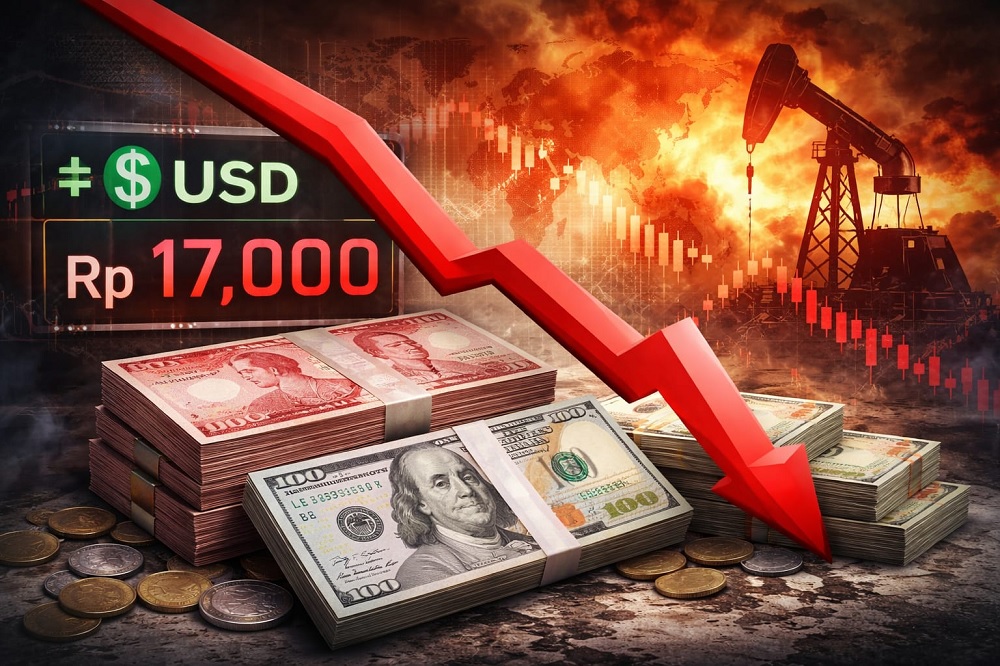
Jakarta, en. SERU.co.id – The Indonesian rupiah experienced a sharp depreciation, breaching the Rp17,000 per US dollar (USD) level during trading on Monday, March 9, 2026. Escalating conflict in the Middle East has bolstered the US dollar’s strength and driven a surge in global oil prices, prompting investors to flock to safe-haven assets and weakening 11 Asian and emerging-market currencies.
As of 3:30 p.m. WIB, the rupiah was trading around Rp16,969 per USD, inching closer to the psychologically significant Rp17,000 threshold that has drawn significant market attention.
Eleven Asian currencies moved uniformly into negative territory against the USD at the start of the week. The Thai baht posted the deepest decline, falling approximately 1.04% to THB 32.09 per USD. The Philippine peso weakened by 1.14% to PHP 59.68 per USD.
South Korea’s won dropped 0.87% to KRW 1,494.1 per USD, while Japan’s yen fell 0.55% to JPY 158.65 per USD. Taiwan’s dollar declined 0.54% to TWD 31.98 per USD, and Malaysia’s ringgit corrected 0.53% to MYR 3.96 per USD.
Additional losses included India’s rupee, down 0.37% to INR 92.27 per USD; Vietnam’s dong, off 0.36% to VND 26,287 per USD; China’s yuan, weaker by 0.32% to CNY 6.91 per USD; and Singapore’s dollar, down 0.3% to SGD 1.28 per USD.
Middle East Conflict Fuels Dollar Strength
Pressure on the rupiah intensified amid rising geopolitical tensions in the Middle East. The conflict involving the United States, Israel, and Iran has triggered a spike in energy prices, boosting demand for safe-haven assets like the US dollar.
Global crude oil prices surged, briefly exceeding more than US$113 per barrel in some reports amid fears of supply disruptions (though benchmarks like Brent settled lower in the range of $100–$110+ in volatile trading following recent escalations involving strikes and threats to key shipping routes like the Strait of Hormuz).
The energy price spike has also raised concerns about higher inflation across multiple countries.
Maybank economist Myrdal Gunarto assessed that the current rupiah weakening is primarily driven by external factors.
“In my view, this is purely from global pressures, especially the broad impact of the war. This is followed by worries about supply chain disruptions or supply shocks,” Myrdal said, as quoted by CNBC on Monday, March 9, 2026.
He noted that global markets are concerned about potential interruptions to world oil supplies due to the conflict, driving investors toward safer assets.
Foreign Capital Outflows Add to Pressure
Beyond global factors, the rupiah faces additional strain from foreign capital outflows from domestic financial markets. Global investors have begun pulling funds from emerging-market stocks and bonds.
Myrdal estimated daily foreign outflows from Indonesia’s stock market at more than US$50 million, while outflows from the government bond market exceeded Rp500 billion.
These conditions have further depressed the rupiah against the USD. In such circumstances, Bank Indonesia is seen as needing to strengthen stabilization measures to prevent excessive volatility.
Possible actions include foreign exchange market interventions in both spot and forward markets, such as Non-Deliverable Forwards (NDF). The central bank could also enter the secondary government debt market to ease bond market pressures.
“Indonesia’s monetary policy space remains quite strong, given substantial foreign exchange reserves. As of last February, Indonesia’s forex reserves stood at around US$151.9 billion,” he added.
In addition to market interventions, Bank Indonesia could bolster liquidity stabilization by increasing the frequency of auctions for Bank Indonesia Rupiah Securities (SRBI) to absorb excess liquidity.
The rupiah’s breach of the Rp17,000 per USD level marks one of the lowest points in its exchange rate history, surpassing the worst levels seen during the 1998 monetary crisis or the COVID-19 pandemic period. (aan/rhd)