
Jakarta, en.SERU.co.id – The Indonesian government has officially declared the start of Ramadan 1447 Hijriah on Thursday, February 19, 2026. This decision stems from an integrated approach combining astronomical calculations (hisab) and direct crescent moon sightings (rukyat), as the hilal (new moon) did not meet visibility criteria across Indonesia on February 17.
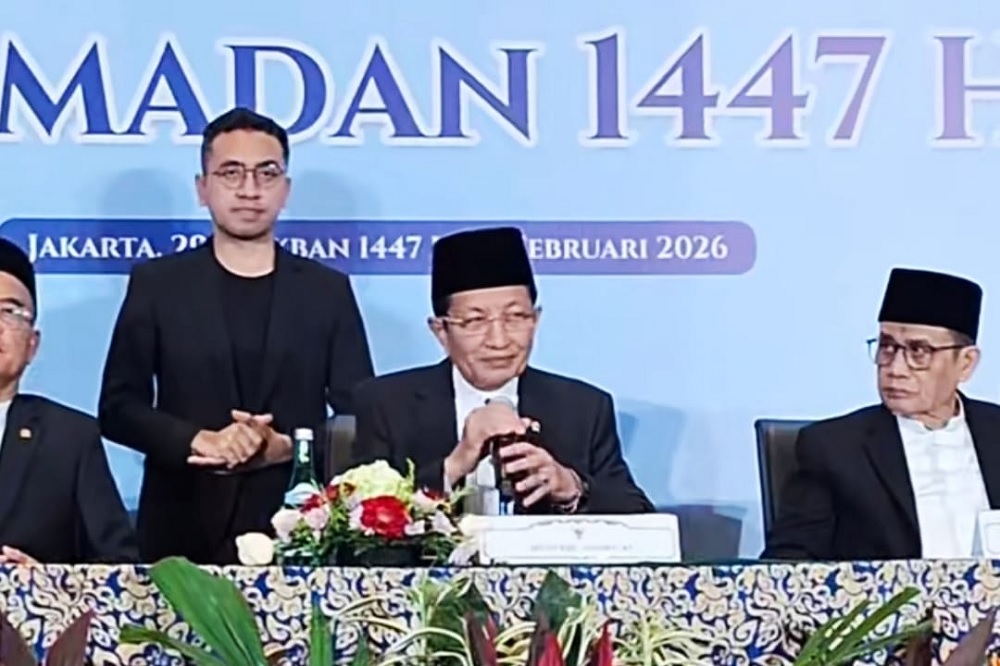
The outcome of the isbat session—a formal confirmation meeting—was announced by the Minister of Religious Affairs of the Republic of Indonesia (RI), involving representatives from the government, Islamic mass organizations (ormas), and scientific institutions.
Minister of Religious Affairs Nasaruddin Umar explained that the determination was reached through consensus among session participants, after carefully reviewing hisab data and rukyat reports from various regions nationwide.
“It has been agreed that 1 Ramadan 1447 Hijriah falls on Thursday, February 19, 2026,” Nasaruddin stated during a press conference on Tuesday, February 17, 2026.
Hilal Not Visible on February 17
This ruling is closely tied to the astronomical conditions observed on the evening of Tuesday, February 17, 2026. At sunset, the hilal’s position remained below the horizon throughout Indonesia, with recorded altitudes ranging from minus 2.41 degrees in the eastern regions to minus 0.93 degrees in the west.
Furthermore, the conjunction (ijtimak)—the alignment of the sun, moon, and earth—occurred at 19:01 WIB (Western Indonesia Time), after sunset. These factors reinforced the conclusion that the hilal did not satisfy visibility requirements for declaring the start of Ramadan on February 18.
The isbat session once again underscored the government’s integrative methodology, blending precise astronomical computations with on-the-ground observations. The administration adheres firmly to the MABIMS criteria (established by the Religious Affairs Ministers of Brunei, Indonesia, Malaysia, and Singapore), which stipulate a minimum hilal altitude of 3 degrees and an elongation (angular separation from the sun) of 6.4 degrees.
This approach ensures a balanced, evidence-based determination that respects both scientific rigor and religious traditions, while accommodating Indonesia’s vast geographical diversity—from urban centers to remote islands—where local sighting conditions can vary due to weather, terrain, and atmospheric factors.
Differences with Muhammadiyah
Prior to the government’s announcement, the Muhammadiyah organization had already set 1 Ramadan 1447 H on Wednesday, February 18, 2026. Their decision relies on the Single Global Hijri Calendar (KHGT), which applies global visibility criteria, considering sightings from anywhere in the world rather than focusing solely on local observations.
Although this results in a one-day discrepancy, the government emphasizes that such variations arise naturally from the distinct methodologies and standards employed by each party. These differences, often rooted in interpretations of Islamic jurisprudence (fiqh) regarding moon sighting—such as the emphasis on global versus local rukyat—highlight the pluralism within Indonesia’s Muslim community, the world’s largest.
Officials urge mutual respect and tolerance to maintain social harmony, especially during the holy month, when unity in worship and community activities is paramount. Historical precedents show that similar divergences have occurred in past years without significant conflict, fostering dialogue and understanding among diverse Islamic groups.
In broader context, this announcement not only guides religious practices for Indonesia’s approximately 240 million Muslims but also influences national planning, including public holidays, school schedules, and economic activities like increased food markets and charitable distributions.
It underscores the government’s role in harmonizing faith with modernity, while edge cases—such as potential disputes in border regions or during adverse weather—may prompt future refinements to the isbat process. Implications extend to interfaith relations, as non-Muslims also participate in Ramadan’s cultural festivities, promoting inclusivity in a multicultural society. (aan/rhd)