

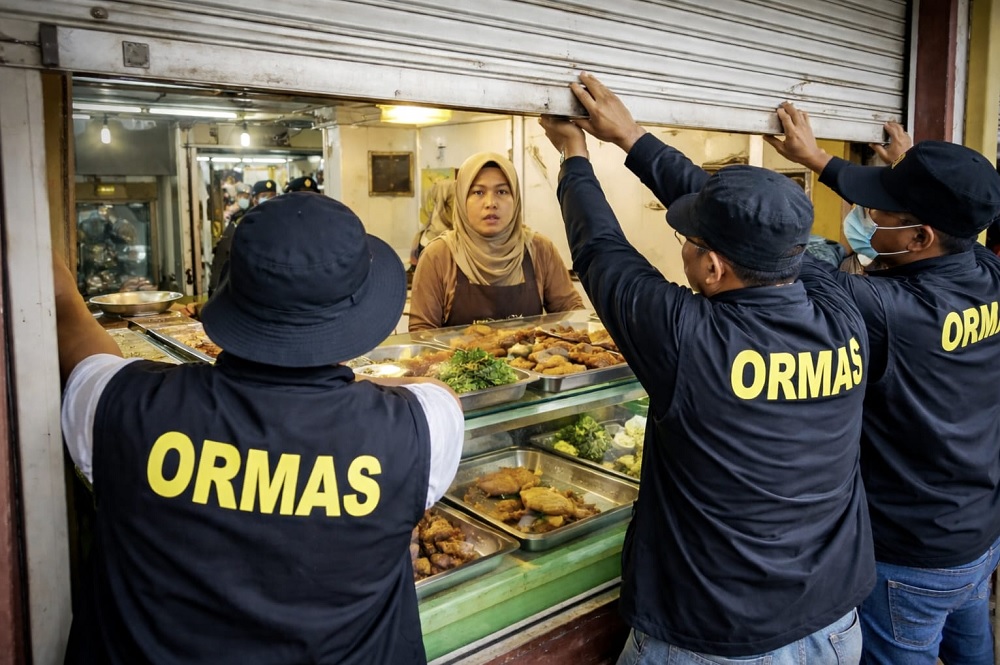
Jakarta, en.SERU.co.id – The issue of sweeping food vendors (warung) during fasting has resurfaced as Ramadan approaches. The Governor of DKI Jakarta has firmly prohibited mass organizations from conducting such sweeps during the holy month. From a religious standpoint, these actions are seen as failing to reflect tolerance, while legally, sweeps are not within the authority of mass organizations but rather that of law enforcement agencies.
DKI Jakarta Governor Pramono Anung has emphasized that he will not permit mass organizations to carry out sweeps on food establishments during Ramadan. He believes such enforcement could lead to unrest and disrupt harmony.
“I want to stress that welcoming Ramadan should be filled with peace and unity,” Pramono declared on Saturday (February 14, 2026).
MUI’s Stance on Sweeping Food Stalls
In agreement, the Chairman of the Indonesian Ulema Council (MUI) for Da’wah and Brotherhood Affairs, KH Cholil Nafis, has stated his opposition to the practice of sweeping. He argues that it contradicts the principle of tolerance, which should be upheld during the holy month.
“Travelers, the sick, and women who are menstruating are granted exemptions from fasting. Therefore, food stalls are still necessary. If no one is selling food, it would actually create difficulties,” Cholil said, as quoted from Republika on Saturday, February 15, 2026.
Cholil also urged Muslims to use Ramadan as an opportunity to strengthen brotherhood. He noted that conflicts and divorces tend to decrease during Ramadan.
Law Enforcement’s Authority for Enforcement
From a legal perspective, the authority to enforce public order does not lie with mass organizations. This responsibility clearly belongs to law enforcement agencies, such as the police and the Municipal Public Order Agency (Satpol PP).
Satpol PP has the power to conduct non-judicial enforcement actions against violations of regional regulations or gubernatorial decrees. However, these actions must follow legal procedures and not extend to judicial processes.
Legal Penalties for Mass Organizations Conducting Sweeps
As reported by Hukumonline, mass organizations are prohibited from usurping law enforcement functions. This ban is outlined in Law No. 16 of 2017. If a mass organization engages in public enforcement, including sweeps, its members can face imprisonment of at least six months and up to one year.
The penalties become more severe if the sweep involves elements of hatred based on ethnicity, religion, race, or group. In such cases, perpetrators can be charged with life imprisonment or a sentence ranging from a minimum of five years to a maximum of 20 years. If accompanied by violence or disruption of public order, the sanction remains imprisonment from six months to one year.
Thus, from religious, local government policy, and national legal perspectives, sweeps of food stalls by mass organizations during Ramadan are not justified. Instead, Ramadan should be interpreted as a month for spreading tranquility and mutual respect amid diversity. (aan/rhd)