

Jakarta, en.SERU.co.id – Prolonged conflict in The Middle East could strain the national budget (APBN) through surging global energy prices and rupiah depreciation. The government is preparing budget austerity measures and energy stabilization efforts to maintain fiscal stability.
Coordinating Minister for Economic Affairs Airlangga Hartarto stated that external pressures could persist for six to ten months, primarily due to sharp rises in global crude oil prices, which would narrow the government’s fiscal space.
Three Economic Impact Scenarios from the Conflict
Government simulations outline varying degrees of pressure on key macroeconomic indicators (baseline assumptions: ICP ~US$70/barrel, rupiah ~Rp16,500/USD, growth ~5.4–5.5%):
- Low-Impact Scenario Indonesian Crude Price (ICP) rises to around US$86 per barrel. Rupiah weakens to approximately Rp17,000 per USD. Economic growth holds at about 5.4%. However, the APBN deficit could widen to around 3.18% of GDP (still near the legal 3% ceiling under state finance laws).
- Moderate-Impact Scenario Greater pressure emerges: ICP climbs to US$97 per barrel. Rupiah depreciates to around Rp17,300 per USD, economic growth dips to about 5.2%, and 10-year government bond (SBN) yields rise to 7.2%. The deficit is projected to expand to approximately 3.53% of GDP, potentially breaching the 3% threshold if sustained.
- Worst-Case Scenario Oil prices could surge beyond US$115 per barrel (with some analyses warning up to US$130 in extreme prolonged disruption). Rupiah weakens to Rp17,500 per USD, growth stabilizes at roughly 5.2%, and the APBN deficit balloons to around 4.06% of GDP—a significant overrun that would require aggressive countermeasures.
These scenarios reflect risks from supply disruptions (e.g., Strait of Hormuz threats), higher import bills for energy (Indonesia remains a net oil importer), and secondary effects like inflation pass-through to food and transport costs.
Government Explores Work-from-Home (WFH) Options
Facing these pressures, President Prabowo Subianto has signaled the need for efficiency across sectors. The government is evaluating multiple cost-saving measures, including reduced office activity for civil servants (ASN).
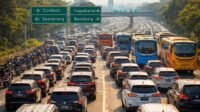
One key option under review is implementing Work from Home (WFH) for portions of government employees. This could cut fuel consumption (estimates suggest potential savings of tens of millions of liters monthly nationwide) and alleviate urban traffic congestion in major cities like Jakarta, Surabaya, and Bandung—especially timely amid the ongoing Lebaran mudik rush.
The President has also floated possibilities for reduced working days or other administrative efficiencies as part of broader state expenditure controls. He emphasized fiscal discipline: “If possible, our ideal is to have no deficit at all. But for now, the most important thing is to ensure the deficit doesn’t grow larger.”
Maintaining Energy Stability
Minister of Energy and Mineral Resources Bahlil Lahadalia assured that subsidized fuel prices (e.g., Pertalite, Solar) will not increase through Eid al-Fitr celebrations. The government has taken anticipatory steps to protect public purchasing power during Ramadan and Lebaran.
For non-subsidized fuels, prices follow market mechanisms. National energy stocks—including gasoline, diesel, and LPG—are confirmed secure ahead of the mudik peak, with Pertamina maintaining buffers (typically 20–23 days of reserves).
Transportation and Distribution Policies
To ease mudik flows, the government has imposed restrictions on heavy goods vehicles (three axles or more) from March 13–29, 2026, on both toll and non-toll roads. Minister of Transportation Dudy Purwagandhi explained this provides more space for private mudik vehicles on main routes. Exemptions apply to essential commodities: fuel, staple foods, fertilizers, and livestock transport to prevent supply chain disruptions.
Priority Programs Remain Unaffected
Despite fiscal strains, key flagship initiatives continue without cuts. Head of the National Nutrition Agency (Badan Gizi Nasional), Dadan Hindayana, confirmed the Free Nutritious Meal Program (MBG – Makan Bergizi Gratis) retains its full Rp335 trillion allocation for 2026 (primarily from core budget plus reserves). Viewed as a long-term human capital investment (targeting ~83 million beneficiaries: schoolchildren, toddlers, pregnant mothers), MBG is excluded from austerity lists.
Other procurements proceed, including operational vehicles: Around 1,200 Mahindra pickup units (from an planned 105,000 import batch from India) have arrived at Tanjung Priok Port in early March 2026, despite prior parliamentary debates. (aan/rhd)