
Jakarta, en.SERU.co.id – The escalating conflict tensions in the Middle East have raised concerns about the implementation of the 2026 Hajj pilgrimage. The Indonesian Government, through the Ministry of Hajj and Umrah, has assured that preparations for the departure of Indonesian pilgrims are still proceeding according to schedule. However, several mitigation scenarios are being prepared in case the security situation worsens.
Minister of Hajj and Umrah Mochamad Irfan Yusuf emphasized that, as of now, the departure schedule for Indonesian Hajj pilgrims has not changed. He stated that the government continues to monitor developments in the region.
“For the time being, there is no change. Hopefully, the conditions remain conducive,” exclaimed Gus Irfan, quoted from Kompas.com, Thursday (March 12, 2026).
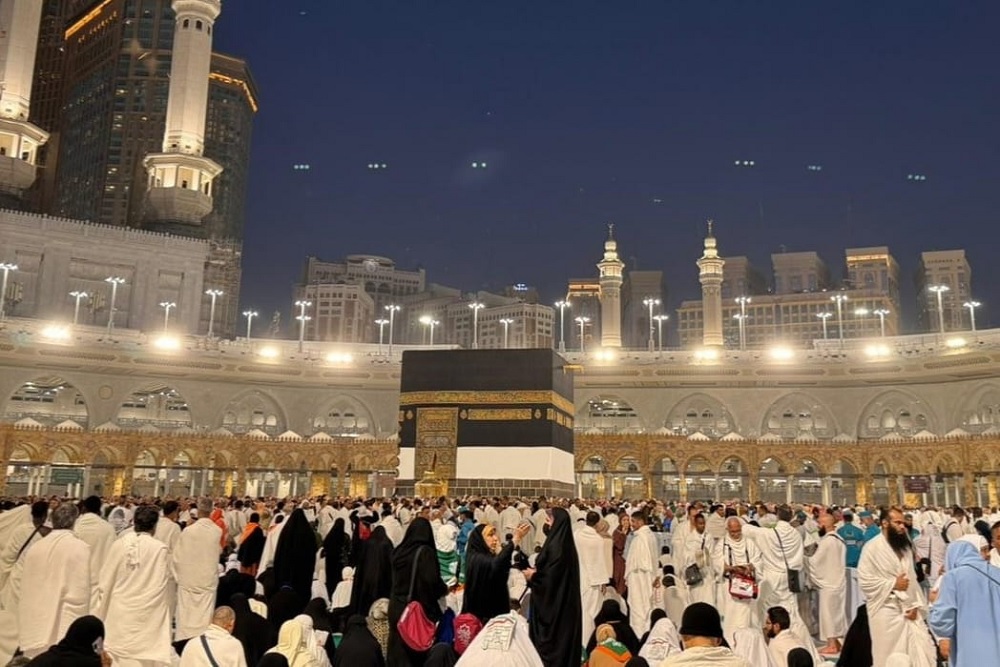
According to Irfan, his ministry is maintaining close coordination with Saudi authorities, particularly to ensure that the holy sites remain safe for pilgrims. The latest information indicates that conditions in Makkah and Madinah are still relatively stable.
Government Prepares Scenarios if Conflict Worsens
The Indonesian Government is not ruling out the possibility of emergency scenarios if the regional conflict escalates further. One mitigation step involves rerouting Hajj pilgrim flights to avoid areas with potential conflict risks, such as Iraq, Syria, Iran, Israel, the United Arab Emirates, and Qatar.
Alternative routes under consideration include a southern path across the Indian Ocean, then entering East African airspace before heading to Saudi Arabia. However, this rerouting could extend flight durations.
If the travel distance is longer, aircraft may need to make technical landings in a third country for refueling. In addition, the government is considering adjustments to flight time slots, particularly to keep departure and return schedules under control.
Another consequence of route changes is the potential increase in Hajj flight operational costs.
Worst-Case Scenario: Indonesia Does Not Depart Pilgrims
In the worst-case scenario, Indonesia decides not to send pilgrims for safety reasons. If this occurs, the government will engage in high-level diplomacy with the Saudi Government to ensure that prepaid service fees do not go to waste.
“Funds already deposited for accommodation and other services are expected to be transferred to the organization of Hajj the following year,” said Gus Irfan.
However, the government recognizes that such contract transfer schemes require agreements with service providers in Saudi Arabia.
Pilgrim Fund Protection Scheme
To anticipate financial impacts on prospective pilgrims, the government has prepared several options for managing BPIH (Hajj Organizing Cost) installment funds. Pilgrims can later choose between two options:
- Withdrawing the installment funds in full, without losing their right to depart in the next Hajj season.
- Leaving the funds stored, so they can be used for departure the following year with added benefits from fund management.
Anticipating Religious Polemics
The Indonesian Government is also preparing a religious communication approach to avoid public controversies, especially if Hajj cancellation becomes necessary.
The Ministry of Hajj and Umrah will coordinate with the Indonesian Ulema Council (MUI), particularly to provide explanations regarding the concept of istitha’ah (capability to perform Hajj) from a sharia perspective.
In certain conditions, the safety of life becomes the top priority. This makes postponement or cancellation of departure permissible under religious principles.
DPR Remains Optimistic Hajj Will Proceed
Meanwhile, Deputy Chairman of Commission VIII DPR RI, Abidin Fikri, expressed optimism that the Middle East conflict will not disrupt the Hajj implementation. According to him, there are currently no signs that the regional conflict is affecting the holy sites of Makkah and Madinah.
“We continue to oversee the comprehensive preparations for Hajj 2026, from regulations and technical aspects to financing. The public does not need to panic,” Abidin said, as reported by detikcom.
He also stressed that there has been no official prohibition notice on Hajj from the Saudi Government, unlike what occurred during the COVID-19 pandemic.
Indonesia’s 2026 Hajj Quota
Based on data from the Nusuk Masar Hajj system, Indonesia’s 2026 Hajj quota reaches 221,000 pilgrims. This includes 203,320 regular Hajj pilgrims (92 percent) and 17,680 special Hajj pilgrims (8 percent).
From the regular quota, 1,050 are allocated for Regional Hajj Officers, and 685 for mentors from Hajj and Umrah Guidance Groups (KBIHU). The average Hajj Organizing Cost (BPIH) for 2026 has been agreed at Rp87.4 million per regular pilgrim.
Impacts if Hajj 2026 Is Canceled
If the cancellation scenario actually occurs, the impact would be significant on Indonesia’s Hajj waiting list system. For illustration, the two-year Hajj cancellation during the COVID-19 pandemic caused waiting times in some regions to surge by decades. Several possible consequences include:
- Shifted queues Pilgrims who fail to depart in 2026 will become priorities for 2027. This shifts those originally scheduled for 2027 to 2028, and so on.
- Increased waiting times With annual quotas fixed at around 221,000 people, canceling one Hajj season could add approximately one year to the average waiting period.
- Potential cost adjustments Currency exchange rate changes and inflation in Saudi service costs could lead to higher Hajj expenses in the following year. (aan/rhd)