

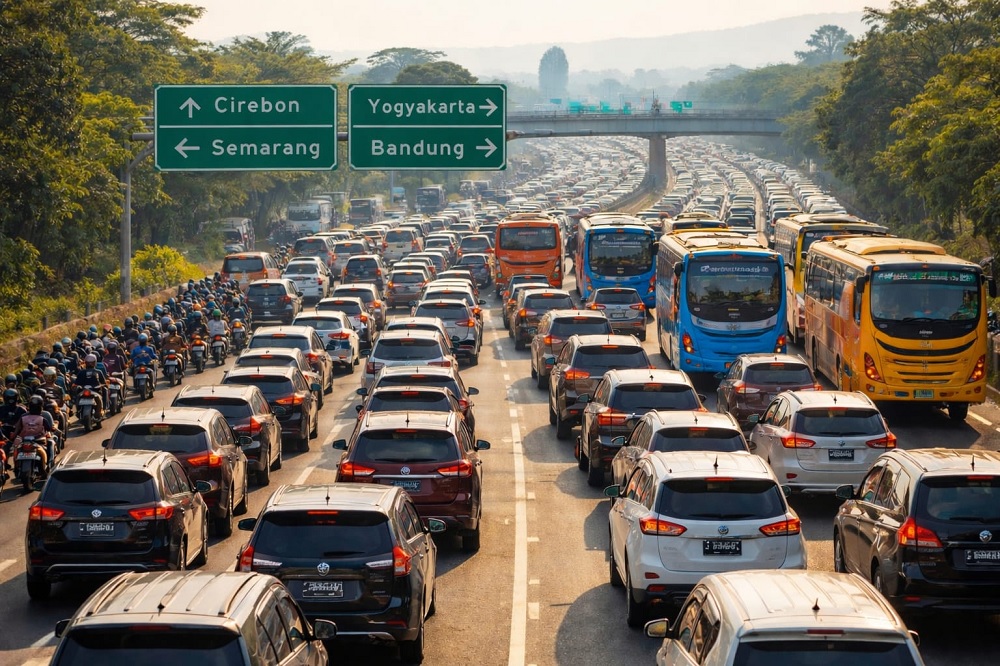
Jakarta, SERU.co.id – The Indonesian government estimates that the Lebaran 2026 homecoming (mudik) flow will reach a massive 143.9 million trips. Peak outbound travel is forecast for 14–15 March and 18–19 March 2026, while the return (balik) rush is expected to hit its highest point on 24–25 March and 28–29 March 2026. The surge in mobility will be dominated by private cars, raising the risk of severe congestion on both toll roads and arterial routes.
Coordinating Minister for Infrastructure and Regional Development Agus Harimurti Yudhoyono (AHY) confirmed the peak mudik periods will fall on 14–15 March and 18–19 March 2026. The return flow is predicted to peak first on 24–25 March, followed by a second wave on 28–29 March 2026.
“Most travelers are expected to head to provinces in Java and South Sulawesi. This high level of mobility will place enormous pressure on the national road network and toll roads,” AHY said, as quoted by Kompas.com on Wednesday (11/3/2026).
To manage the anticipated chaos, the government is rolling out several measures, including the Work From Anywhere (WFA) policy. Officials hope WFA will reduce the number of people traveling at peak times and prevent extreme gridlock.
Private Vehicles Still the Top Choice
Transportation Minister Dudy Purwagandhi revealed that private cars remain the overwhelming favorite. Around 52 percent of mudik travelers – an estimated 76.24 million people – are expected to drive their own vehicles home.
“Nationally, private car users during the mudik period are projected to reach 76.24 million people, far surpassing motorcycles, buses, or other modes of transport,” he said.
The majority of these drivers (50.63 million) are expected to use toll roads, turning the toll network into the main bottleneck. Meanwhile, motorcycle riders (around 8.65 million) are likely to avoid the main tolls and take alternative arterial roads and connecting routes instead.
“This movement pattern requires special attention in traffic management. Congestion will not only hit toll roads but also arterial routes used heavily by motorbikes,” Dudy added, as reported by Sindonews.
Vehicle movement is expected to be heavily concentrated toward eastern Java. Of approximately 3.5 million vehicles, about 50 percent are predicted to head east through toll sections such as Cipularang to Purbaleunyi, serving West Java and Central Java. Another 28 percent are expected to travel toward Merak, while 20 percent will head south to the Bogor area and surroundings.
7,000 Health Posts Prepared Along Routes
On the health front, the government is setting up around 7,000 health posts to support travelers’ safety. Health Minister Budi Gunadi Sadikin announced that the posts will be located on both toll and non-toll routes, with many placed at mosques along the Pantura (North Java Coast) road.
“Many travelers stop at mosques to rest or pray, so we chose those locations,” he explained.
Besides medical checks, the posts will offer resting areas, food, and places to break the fast. The Health Ministry is also running a driver health screening program to lower the risk of traffic accidents.
“The government is considering providing measles vaccinations for children at selected health posts,” the minister concluded. (aan/rhd)