
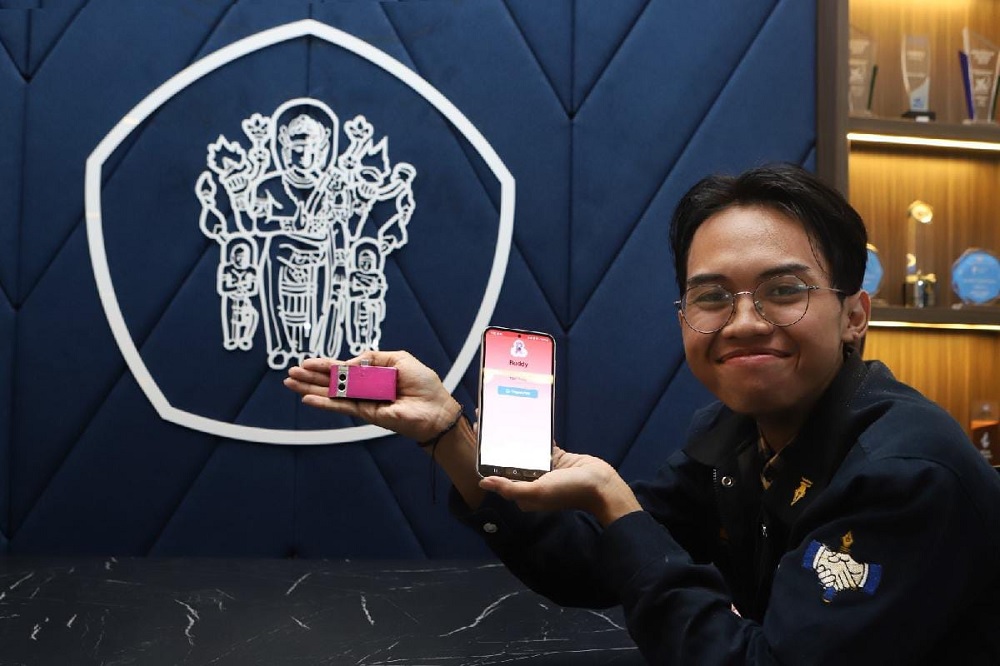
Malang, en.SERU.co.id – Four students from Universitas Brawijaya (UB) have successfully developed an innovative early breast cancer detection device called BUDDY, earning them runner-up (second place) in the International Student Competition 2026, organized by CEM UPM Malaysia.
The team consists of Dastino Putra Rendy Lovind and Anggie Fadillah Dwiva from the Bioprocess Engineering program at the Faculty of Agricultural Technology (FTP), along with Livy Noer Azizah and Rifda Alfia Safina from the Food Science and Technology program at FTP UB.
Dastino explained that BUDDY stands for Breast Urgency Detection Device with Thermography. This system uses thermal camera technology combined with artificial intelligence (AI) for rapid and practical early detection of breast cancer.
“The device is designed to enable quick and convenient detection through a mobile app. With the thermal camera, the system can deliver analysis results in approximately 5 to 10 seconds,” Dastino said.
The development of BUDDY was motivated by the high incidence of breast cancer cases in Indonesia, coupled with limited public awareness of existing detection methods such as SADARI (self-breast examination) and SADANIS (clinical breast examination).
“Through this innovation, our team aims to provide an alternative self-examination option that can be done at home. The app first prompts users to complete a survey,” he added.
Next, users capture images of their breasts using the thermal camera from a horizontal distance of about 60 cm. The scan data is then sent to the BUDDY system via a hosting server for AI analysis.
“The AI has been trained on thousands of image samples, including the DMR dataset, Roboflow annotations, and the YOLO v8 AI model. It can detect indications of breast cancer while providing details on location, size, and even the possible disease stage,” Dastino elaborated.
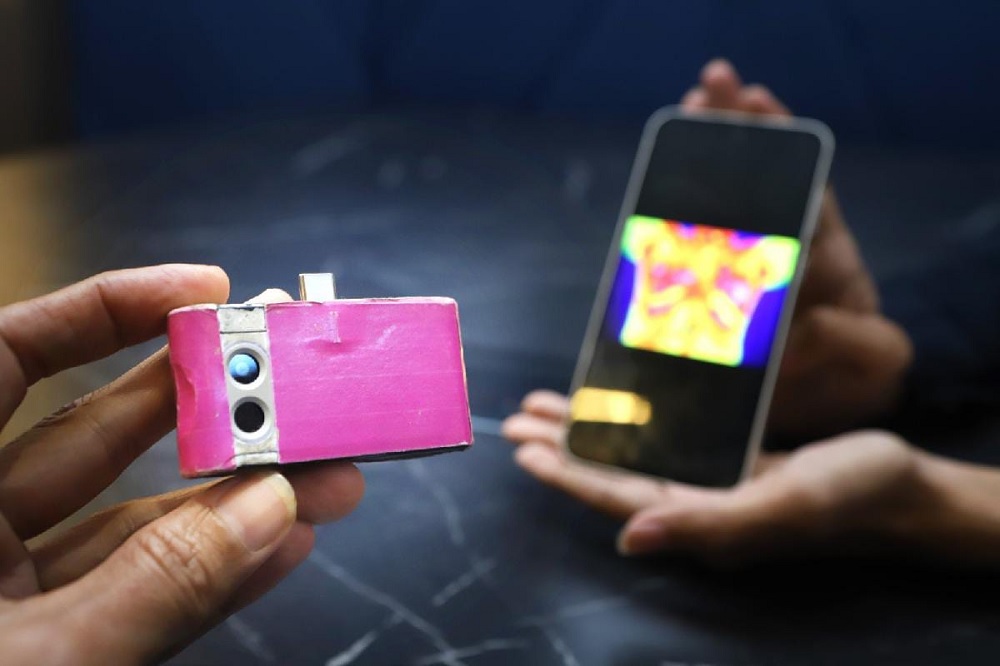
In simple terms, BUDDY combines two main components: a thermal camera as the “eye” to capture body temperature images, and AI-based software as the “brain” to analyze the scan data.
Despite their international success, the journey to the competition was challenging. Dastino mentioned facing funding difficulties for the final stage.
“Fortunately, the faculty and team provided financial support, though it didn’t fully cover the needs. We hope that funding support for students participating in international competitions will be strengthened in the future,” he said.
Dastino also encouraged other students to boldly participate in various competitions. “No matter the innovation, it must be continuously developed until it’s ready for widespread use. Victory only comes to those who dare to try first. We hope BUDDY can be commercialized with support from the government and related parties,” he added.
As an initial step in intellectual property protection, BUDDY’s technology has been patented with registration number EC00202467457, filed on July 18, 2024. (bas/rhd)