

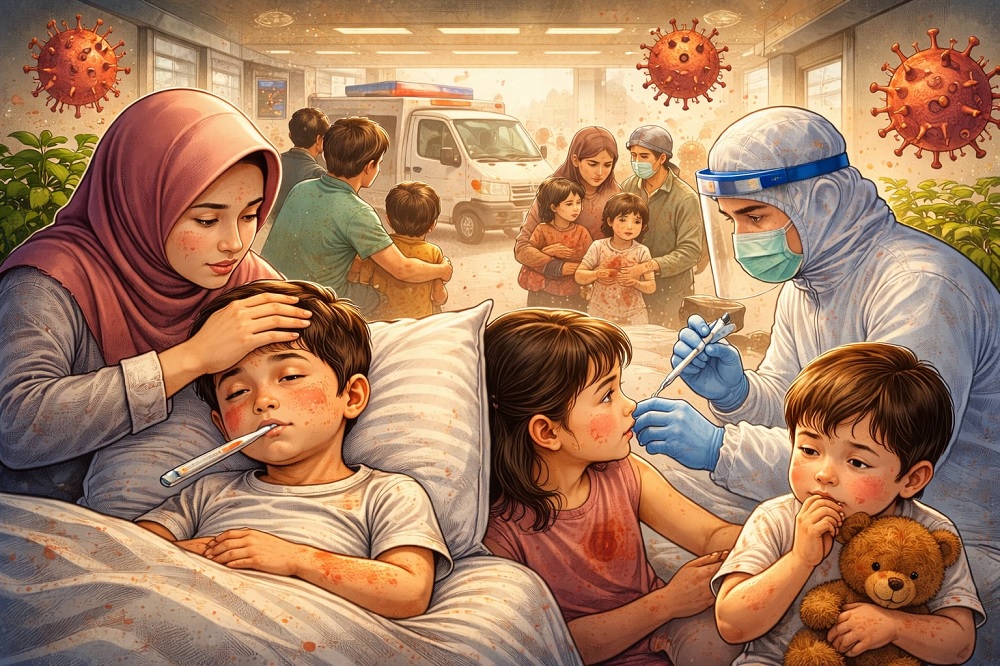
Malang, en.SERU.co.id – Indonesia has confirmed hundreds of measles cases with several fatalities among children as of February 2026. According to the Ministry of Health (Kemenkes), the majority of affected individuals had no history of vaccination. Authorities emphasize that full vaccination remains the most effective way to prevent this highly contagious disease.
Aji Muhawarman, Head of the Communication and Public Services Bureau at Kemenkes, stated that from January to February 2026, there were 8,810 suspected cases, 572 laboratory-confirmed cases, and 5 deaths.
“Around 67% of confirmed cases had no immunization history, and all deaths occurred in unvaccinated infants and toddlers,” Aji said, citing the Kemenkes website on Thursday, March 5, 2026.
The surge peaked in mid-January 2026, with up to 420 suspected cases in a single day and 40–45 lab-confirmed daily. Compared to recent years, measles cases have risen steadily from 2023–2025. In 2025 alone, there were 63,769 suspected cases, 11,094 confirmed, and 69 deaths.
As of week 7 in 2026, records show 8,224 suspected cases, 572 confirmed, and 4–5 deaths, with 21 suspected outbreaks (KLB) and 13 lab-confirmed outbreaks across 17 districts/cities in 11 provinces.
Acting Director General of Disease Control, dr. Andi Saguni, stressed that measles spreads very easily and requires rapid response through strong surveillance and timely reporting. Case detection in 2025 rose 147% from 2024, prompting enhanced early warning systems like epidemiological investigations within 24 hours and real-time reporting via SKDR.
Incomplete Immunization Remains a Key Challenge
Beyond uneven vaccination coverage, vaccine hesitancy—fueled by fears of adverse events, perceptions that vaccines are unnecessary, and widespread social media misinformation—has deterred some parents from completing their children’s shots.
Dr. Mulya Rahma Karyanti, a pediatric infectious and tropical diseases consultant at RSUPN Dr. Cipto Mangunkusumo, noted that outbreaks often occur in areas with low immunization rates.
“Nationally, measles-rubella coverage exceeds targets, but pockets of low uptake heighten outbreak risks,” she explained.
Globally, measles cases are also rising in regions like Southeast Asia and the Western Pacific, increasing cross-border transmission risks.
Understanding Measles and Prevention
Measles is caused by the measles virus and spreads via respiratory droplets from coughing, sneezing, or talking. Symptoms include high fever, cough, runny nose, red watery eyes, and a widespread red rash.
The most effective prevention is complete immunization, particularly the MMR vaccine (measles, mumps, rubella). Additional recommended steps include:
- Completing children’s vaccinations per the national schedule.
- Practicing cough/sneeze etiquette and wearing masks when ill.
- Washing hands regularly with soap and running water.
- Maintaining cleanliness and good ventilation in homes and schools.
- Educating families on early symptoms and seeking prompt medical care. (aan/rhd)